This Sunday past I took my mother for another one of our little drives. We went to see St Mary's, Our Lady of Seven Sorrows in Kitchener. The church was celebrating the feast day of their patroness, but it is a day of special significance because of the peculiar "phenomena" that occurs at this church every year on this day.
As the sun sets, around seven o'clock or so, the rays of the setting sun pass through a tiny piece of red glass in one of the stained glass windows, and the red light lands precisely on the sword pierced heart of the statue of Mary on the high altar. (The high altar is, by the way, one of the Durrer altars I have mentioned previously.) The church tells the story of the phenomena as well as the story of a miracle that may be associated with that same statue here.
Because it was a Sunday, the parish turned it into an all day event. They had rosary followed by exposition, followed by benediction followed by a modified rosary to our Lady of the Seven Sorrows, followed by Mass at seven o'clock. Also because it was a Sunday, they expected a larger than usual crowd.
I think they got a wee bit more than they anticipated. The church was almost packed when Mom and I arrived around four the parking lot was nearly full. There were school buses bringing people in. Word about the phenomena had gotten out, and people were travelling some distance to come and see this, some kind of sign.
The sign was not to come this time, however. Though the weatherman called for cloudy with intermittent sunny periods, the day was miserable and rainy, and the cloud cover never broke, not even once. (I plan on inaugurating a "slug a weatherman" day, real soon.)
And yet, the people stayed. There was a crowd when we arrived, and people still kept coming, filling the church to its absolute maximum capacity and beyond. They stayed through the exposition and the benediction, and they stayed through the prayers and they stayed through the Mass, even though it was obvious no sign would be coming.
A few notes about some things from that day.
At one point, I went to the washroom in the basement. As was usual, there was a very long line to get into the women's washroom, but, unusually, there was also a short line to get into the men's. We stood there grumbling about how long this was taking as we hopped from foot to foot, (the women who were beside us in their own line were blandly unsympathetic) and someone commented that whoever was in there was acting like a woman. And then the door opened, and out came... a woman. She had gotten tired of waiting in her line and jumped the queue to use ours. Is that fair?
I would be remiss not to mention the music. I have of late tried to mostly shut out the music that is sung at church, for I often find myself rating the music and the performance, which is contrary to the spirit of worship. One should come to Mass as a humble believer, not as an arrogant critic. Having said that, I will say this much: I did not have high expectations for the music. Almost all the choirs I have heard sing Mass have been composed of a small group of well meaning souls who are doing their very best to sing for the Glory of God. Occasionally they even sing in tune. On rare occasions I have heard a good choir. However, this choir was excellent and their choice in music was top notch. They sang Elgar Ave Verum, and Pergolesi's Stabat Mater, and a series of chants and settings with which I was not entirely familiar. Even the more standard Catholic hymns seemed to have been rearranged by the director and sounded far better than I have almost ever heard before. Full praise is due to both the director and the choir.
When Mass was over, the church had been so filled that mother and I remained seated for five minutes or more while the Organist hammered out some Bach for the postlude. I wouldn't have gone anywhere anyway while that was playing, but the point was we couldn't because of the size of the crowd streaming out past us.
It was a wonderful day. Mother liked the day immensely, and we both felt uplifted by partaking in the event. We may not have seen the phenomena, but I believe we saw something greater: a church filled with people worshipping God, staying even though it was obvious the sign they came to see was not going to happen.

Showing posts with label Another post most readers couldn't care less about. Show all posts
Showing posts with label Another post most readers couldn't care less about. Show all posts
17 September 2013


2 September 2013

1 September 2013
The Prudence of Slaughter.
Yesterday, Puff got into a debate on Facebook with a priest on the subject of capital punishment. The priest thought some guy down in the States should be fried at the earliest possible convenience, apparently with maximal cruelty. When Puff pointed out that the Catechism of the Church states that the death penalty is to be avoided if at all possible, he responded that this was prudential judgement.
I see several issues here: First, the Catechism. Second, prudential judgement. Third, the Death Penalty, and my own opinions pertaining thereto, because, hey, this is my blog.
So first, the Catechism:
Fairly straightforward. The only acceptable reason for the death penalty is if there is no other way to protect people. "Guy has it coming" is not an acceptable reason.
Second: Prudential Judgement. I admit I am not entirely certain what this phrase means, although I have seen it used many, many times. Thus, even though I am not entirely certain what a prudential judgement means, I can tell how it is used. It is used almost exclusively by those who consider themselves to be politically right wing, and they use it in almost the exact same way that left wingers use the phrase "primacy of conscience": as a way to blow off a teaching of the Church with which they disagree, or perhaps find inconvenient.
Both those who identify themselves as left and those who identify as right wingers should understand that the Church is neither left nor right. Further, they should stop trying to force the Catechism to say what they want it to say and instead see what it does say, and, above all, stop teaching others how to get around the teachings they do not like. The Church's teaching here is difficult, and it calls upon the faithful to be wise and to weigh matters as best they might before deciding. Difficult teachings are the ones we are most inclined to blow off or at least sidestep. They are also the ones we should heed the most.
Finally, me. I have heard of the stories of many heinous murders, and know that monsters walk among us. I know the names of many of these monsters and their victims, and there are times when I wish upon them the most gruesome forms of vengeance my mangled soul can devise that the darkness they visited upon the innocent of this world may be doubly redoubled upon them.
But I also know other stories and other names. I know Donald Marshall, Guy Paul Morin, David Milgard, and yes, Steven Truscott. All innocent men who were found guilty beyond a reasonable doubt by their peers, and sentence to long terms in prison, and all innocent of the charges levied against them. When I think of their stories, I am profoundly grateful that Canada has abolished the death penalty.
Crimes are committed by people, then investigated by people, and judged by people. Mistakes are sometimes made. Occasionally, we send the wrong person to jail. If we had the death penalty, it is inevitably that we would from time to time kill an innocent. I find that unacceptable. It is a terrible thing to lock up an innocent man, but at least there is time to review the case, realise the mistake, and restore the man to society as best we can. There is no restoration for the dead, and an apology to a corpse is nothing but a most bitter irony.
At its heart, the Church's teaching on the death penalty is minimalist. It may be used only in extreme situations, and only if there is no other way. Those who, like the good father, endorse the death penalty, tend to be maximalist: kill early, kill fast, kill often. This they call prudential judgement. I can not believe it is so. There is no prudential judgement for slaughter.
I also believe priests should not be teaching others ways to ignore the Church's teaching.
I see several issues here: First, the Catechism. Second, prudential judgement. Third, the Death Penalty, and my own opinions pertaining thereto, because, hey, this is my blog.
So first, the Catechism:
2267 Assuming that the guilty party’s identity and responsibility have been fully determined, the traditional teaching of the Church does not exclude recourse to the death penalty, if this is the only possible way of effectively defending human lives against the unjust aggressor..
If, however, nonlethal means are sufficient to defend and protect people’s safety from the aggressor, authority will limit itself to such means, as these are more in keeping with the concrete conditions of the common good and are more in conformity to the dignity of the human person.
Today, in fact, as a consequence of the possibilities which the state has for effectively preventing crime, by rendering one who has committed an offense incapable of doing harm - without definitely taking away from him the possibility of redeeming himself - the cases in which the execution of the offender is an absolute necessity are very rare, if not practically nonexistent
Fairly straightforward. The only acceptable reason for the death penalty is if there is no other way to protect people. "Guy has it coming" is not an acceptable reason.
Second: Prudential Judgement. I admit I am not entirely certain what this phrase means, although I have seen it used many, many times. Thus, even though I am not entirely certain what a prudential judgement means, I can tell how it is used. It is used almost exclusively by those who consider themselves to be politically right wing, and they use it in almost the exact same way that left wingers use the phrase "primacy of conscience": as a way to blow off a teaching of the Church with which they disagree, or perhaps find inconvenient.
Both those who identify themselves as left and those who identify as right wingers should understand that the Church is neither left nor right. Further, they should stop trying to force the Catechism to say what they want it to say and instead see what it does say, and, above all, stop teaching others how to get around the teachings they do not like. The Church's teaching here is difficult, and it calls upon the faithful to be wise and to weigh matters as best they might before deciding. Difficult teachings are the ones we are most inclined to blow off or at least sidestep. They are also the ones we should heed the most.
Finally, me. I have heard of the stories of many heinous murders, and know that monsters walk among us. I know the names of many of these monsters and their victims, and there are times when I wish upon them the most gruesome forms of vengeance my mangled soul can devise that the darkness they visited upon the innocent of this world may be doubly redoubled upon them.
But I also know other stories and other names. I know Donald Marshall, Guy Paul Morin, David Milgard, and yes, Steven Truscott. All innocent men who were found guilty beyond a reasonable doubt by their peers, and sentence to long terms in prison, and all innocent of the charges levied against them. When I think of their stories, I am profoundly grateful that Canada has abolished the death penalty.
Crimes are committed by people, then investigated by people, and judged by people. Mistakes are sometimes made. Occasionally, we send the wrong person to jail. If we had the death penalty, it is inevitably that we would from time to time kill an innocent. I find that unacceptable. It is a terrible thing to lock up an innocent man, but at least there is time to review the case, realise the mistake, and restore the man to society as best we can. There is no restoration for the dead, and an apology to a corpse is nothing but a most bitter irony.
At its heart, the Church's teaching on the death penalty is minimalist. It may be used only in extreme situations, and only if there is no other way. Those who, like the good father, endorse the death penalty, tend to be maximalist: kill early, kill fast, kill often. This they call prudential judgement. I can not believe it is so. There is no prudential judgement for slaughter.
I also believe priests should not be teaching others ways to ignore the Church's teaching.
10 August 2013
Shall we use our words to heal or to hurt?
There are days, many days, when I read fellow Catholic bloggers- whether of the more traditional or less so variety- and I am disgusted and embarrassed by the amount of bile and hatred and snark they publish. I am not going to print names or cite examples. There are too many.
I know most of them are unaware of the existence of this blog, and almost none of them would read these words. On the occasions I have tried to speak to them, I have been dismissed and deleted. I have all but given up on trying to speak to them. But if I were to try again, I would say this: Many of you were not Catholic originally but converted to the faith. Many of you were lapsed Catholics who came back. Did you convert or return to the Church because someone called you an idiot, or mocked you, or called you a heretic or a pharisee? Did you come back because they posted your errors for all to see? Was it their talent for snark that convinced you this faith was the true one? If it wasn't, then ask yourself if you would be convinced by such tactics. If, as I suspect, the answer is no, then ask yourself why you would try to persuade people using tactics which at best you yourself would not find persuasive, and at worst, would drive you further away?
Who is served by all this snark, by dismissing the opinions of those who disagree with you in a way that denigrates them and elevates you? Is it done for the glory of God, or for your greater glory? Have you served the new evangelism by bringing people closer to the Truth, or have you betrayed its goals, and driven them away?
I, for one, would never be convinced of the existence of Christian Charity from reading the bloggers. Our actions towards each other are scandalous and a stumbling block for others. It is time, it is past time we set them aside, and acted like we believed our faith to be true.
I know most of them are unaware of the existence of this blog, and almost none of them would read these words. On the occasions I have tried to speak to them, I have been dismissed and deleted. I have all but given up on trying to speak to them. But if I were to try again, I would say this: Many of you were not Catholic originally but converted to the faith. Many of you were lapsed Catholics who came back. Did you convert or return to the Church because someone called you an idiot, or mocked you, or called you a heretic or a pharisee? Did you come back because they posted your errors for all to see? Was it their talent for snark that convinced you this faith was the true one? If it wasn't, then ask yourself if you would be convinced by such tactics. If, as I suspect, the answer is no, then ask yourself why you would try to persuade people using tactics which at best you yourself would not find persuasive, and at worst, would drive you further away?
Who is served by all this snark, by dismissing the opinions of those who disagree with you in a way that denigrates them and elevates you? Is it done for the glory of God, or for your greater glory? Have you served the new evangelism by bringing people closer to the Truth, or have you betrayed its goals, and driven them away?
I, for one, would never be convinced of the existence of Christian Charity from reading the bloggers. Our actions towards each other are scandalous and a stumbling block for others. It is time, it is past time we set them aside, and acted like we believed our faith to be true.
3 August 2013
If Only
Of all the thoughts that are deadly to human contentment, few are deadlier than these two words: "if only..."
These words haunt our thought of the past and our desires of the future. "If only this had happened, if only I had done this instead of that, everything would be better." "If I only had that thing, then I would be happy." We place our happiness on some impossible past, where everything would have turned out sunshine and roses, or as if advertisers were correct and things can give us happiness, despite the fact that the euphoria we were promised over and over again never quite materialised. Maybe this time it will work.
These thoughts take us away from the present, the moment in which we live, and defers our contentment to some future time, or places it in some imagined history, as though it were possible for mere humans to know with certainty what might have happened.
People, or some people, at least, knew this truth. Some even put it down, so their fellow men, even those not yet born, could learn from their hard won wisdom. But, as Uncle Screwtape pointed out, only the learned read the old books, and of all people, they are the least likely to derive any benefit from them.
It was true in C.S. Lewis's time, it is even more true now, when the Historical point of view has given way to the ahistorical deconstruction, which tells its students that every writer who thought they were saying something was in fact saying nothing. As a result, when a modern student of literature reads a passage wherein a writer of the past confronts one of the central paradoxes of man's existence, he will not wonder if this writer saw the truth, and got it right, or even if the author got it wrong and how. They will not wonder if they themselves were wrong, and if they should change their lives.
To bring this post back to its original subject, the writer of old knew about the desires of the heart, and the yearning that says if only. Shakespeare wrote about it in several of his plays, but in none better than in Richard the Second. Here the deposed Richard considers his condition, and whether he is better off as a king, or as a beggar:
Thus play I in one person many people,
And none contented: sometimes am I king;
Then treasons make me wish myself a beggar,
And so I am: then crushing penury
Persuades me I was better when a king;
Then am I king'd again: and by and by
Think that I am unking'd by Bolingbroke,
And straight am nothing: but whate'er I be,
Nor I nor any man that but man is
With nothing shall be pleased, till he be eased
With being nothing.
Simple truth from clearly and brightly seen from the dim and dusty past: There are no "if only's" nothing will bring contentment, till we are contented with nothing.
These words haunt our thought of the past and our desires of the future. "If only this had happened, if only I had done this instead of that, everything would be better." "If I only had that thing, then I would be happy." We place our happiness on some impossible past, where everything would have turned out sunshine and roses, or as if advertisers were correct and things can give us happiness, despite the fact that the euphoria we were promised over and over again never quite materialised. Maybe this time it will work.
These thoughts take us away from the present, the moment in which we live, and defers our contentment to some future time, or places it in some imagined history, as though it were possible for mere humans to know with certainty what might have happened.
People, or some people, at least, knew this truth. Some even put it down, so their fellow men, even those not yet born, could learn from their hard won wisdom. But, as Uncle Screwtape pointed out, only the learned read the old books, and of all people, they are the least likely to derive any benefit from them.
When a learned man is presented with any statement in an ancient author, the one question he never asks is whether it is true. He asks who influenced the ancient writer, and how far that statement is consistent with what he said in other books, and what phase in the writer's development...To regard an ancient writer as a possible source of knowledge- to anticipate that what he said could possibly modify your thoughts or behaviour- this would be rejected as unutterably simple minded. And since we cannot deceive the whole human race all the time, it is most important thus to cut every generation off from all others; for where learning makes a free commerce between the ages there is always the danger that the characteristic errors of on may be corrected by the characteristic truths of another.
It was true in C.S. Lewis's time, it is even more true now, when the Historical point of view has given way to the ahistorical deconstruction, which tells its students that every writer who thought they were saying something was in fact saying nothing. As a result, when a modern student of literature reads a passage wherein a writer of the past confronts one of the central paradoxes of man's existence, he will not wonder if this writer saw the truth, and got it right, or even if the author got it wrong and how. They will not wonder if they themselves were wrong, and if they should change their lives.
To bring this post back to its original subject, the writer of old knew about the desires of the heart, and the yearning that says if only. Shakespeare wrote about it in several of his plays, but in none better than in Richard the Second. Here the deposed Richard considers his condition, and whether he is better off as a king, or as a beggar:
Thus play I in one person many people,
And none contented: sometimes am I king;
Then treasons make me wish myself a beggar,
And so I am: then crushing penury
Persuades me I was better when a king;
Then am I king'd again: and by and by
Think that I am unking'd by Bolingbroke,
And straight am nothing: but whate'er I be,
Nor I nor any man that but man is
With nothing shall be pleased, till he be eased
With being nothing.
Simple truth from clearly and brightly seen from the dim and dusty past: There are no "if only's" nothing will bring contentment, till we are contented with nothing.
28 July 2013
Settling for smaller heroes.
I saw The Man of Steel a while back. Since then, whenever I have mentioned in conversation that I saw the movie, I am inevitably asked if I liked it, and my answer has been "Yeah, mostly, but..." I have even asked myself: was it a good movie or not, and I draw a blank. Was it good? Was he as good as any Superman of yore?
Spoiler alert: I make no attempt to hide the plot. I waited until pretty much everyone who planned to see the movie saw it, so here goes.
Bringing a comic book movie to life on the screen is not like making a movie from a novel. Many comic book characters have been around for decades, with hundreds upon hundreds of issues and stories that could be told. The writers and directors of a movie adaptation are not bringing to the screen any particular story, but are rather bringing a character to the screen. So the issue is not whether the movie was true to the story, but whether or not the movie was true to the character. For superheroes, the character issue is usually twofold: there is the superhero character, but also the character of the human side of the hero- his or her secret identity.
In broadest terms, the two main companies that produce comics in North America- DC and Marvel- have chosen two different paths when it comes to the balance of the super vs the normal. In DC, generally speaking, it is the heroic identity that is the primary identity. Those of you who are old enough to remember the old Superman TV shows and serials may remember the old introduction. It began it "Faster than a speeding bullet!...." but it included "Disguised as mild mannered reporter Clark Kent..." Clark Kent was Superman's disguise, and not the other way around, because he really was Superman, and really wasn't Clark Kent. In Marvel, on the other hand, we have characters like the Fantastic Four, who have made no attempt to hide their identity and have blended the super and the mundane. There is also, far more popularly, Spiderman. Peter Parker is not Spiderman's disguise- Spiderman is Peter Parker's disguise, because he really is Peter Parker, a boy who is driven by guilt to occasionally put on a suit and stop the bad guys.
Part of this balance, for Marvel, is that the Marvel characters tend to pay a high price for being super. Peter Parker deeply wishes that he could stop being Spiderman and go back to being a normal guy. Bruce Banner's power of turning into a seven foot tall green rage monster has ruined his life completely. In the classic Superman, or Batman, or pretty much any DC comic I can think of, the heroes do not have to pay that price or suffer the angst that the Marvel characters do. "Is this the price I must pay for being Spiderman?" is a question Peter Parker often asks himself. The equivalent question would never cross Superman's mind.
That is, until fairly recently. Recent television shows- by "recent" I mean within the last twenty or so years- based on the character have tended to focus on Superman's more human persona, rather than the man in the blue tights. "Lois and Clark" was a show mainly about the romance between the two. In Smallwille, Clark only takes on the suit at the very end of the show, in a brief glance at what he has become. These shows reverse the usual balance and take a more Marvelesque approach to the character.
Oddly, though, in the movie adaptations Marvel tends to be lighter fare, the comic book roots still readily apparent in the movies. It is broad cast to the audience at the beginning of every Marvel movie, where we see comic book pages flipping until the Marvel logo appears on the screen. The character angst that fills Marvel's comics is present in their movies, but it doesn't often darken the movie. Their finest movie, in my opinion, Spiderman 2, played on this angst greatly, and then ultimately resolved it. Peter didn't want to be Spiderman and even stopped for a time, but then he took back the mantle of Spiderman to help others, even though he knew it would cost him his dream of a normal life. And then, his dream reappears in his doorway, for Mary Jane has come, and has decided it was time someone saved him.
DC, on the other hand, has been making far, far darker movies. The directors have sought- successfully, I would say- to create the most unlikely creation of all: plausible superhero movies. What would happen, these movies seem to ask, if these characters existed in our world? The Batman saga leaves Batman with the question of whether or not he was actually doing any good. In the name of law and order he takes down many mob bosses only to find himself damned by his own success, for he has created a power vacuum, into which steps chaos incarnate in the form of the Joker.
The Batman movies, particularly the third, were some of the most frustrating creations I have ever seen on screen. I still do not, even now, more than a year later, know what I think of the third movie. There was much that was right, and much that was wrong. Batman was good, as was Gordon and Alfred. Bane made a good villain, who worthily defeated the Batman early in the movie, until we learn that Bane was really a nobody, a flunky. Nothing special. This weakened the character of Batman immensely, as a hero is only as strong as his enemies. Jack the Giant Killer is impressive because Giants are impressive. George the Dragon Slayer is awe inspiring because dragons are awe inspiring. Tim the Fly Swatter is not worth talking about. So having Batman defeated by No One Particular was frustrating. And there was also the character of Catwoman. I believe Anne Hathaway did a good job with what she had, but what she had was completely wrong. Catwoman is supposed to be both playful and dangerous. The movie had her bored and sullen.
So I was curious to see what they would do with Superman. Would they make the Big Blue Boy Scout a darker character, and would it work? Or would they betray the character? How would they make it plausible?
First thing to think about is the balance of character- is he Superman, who sometimes cunningly disguises himself with glasses, or is he Clark Kent in a circus strongman's outfit? The answer is neither. They haven't really dealt with that issue. He is basically both in this movie. He is both Clark and the guy in the suit, and there is little difference between the two. The end of the movie sets up the idea that he will play at being a mild mannered reporter, but by then one of the basic elements of the canonical Superman story has already been removed: the love triangle The Clark Loves Lois Who Loves Superman Who Is Really Clark But Can't Say So is missing from this movie. In fact, Lois, being the crack reporter she is, figures out who Superman is in a five minute montage. So that's gone and it won't be present in the next movie either. At least we won't have a repeat of Christopher Reeve erasing her memory, and then giving it back, then erasing it again... I hope.
Zod is a suitably impressive villain, and one of the best things in this movie. He makes a worthy adversary for Superman- sort of. Zod is supposed to be a bred and trained warrior, with every fibre of his being deidcated to the art of battle, yet on Krypton he is soundly beaten by the born and bred scientist, Jor El, Clark's father, and onlyt manages to beat Jor El when Jor El is distracted. So one wonders how good and worthwhile all that training was. It certainly doesn not keep him from being defeated and killed at the hands of Superman, who, the movie points out, had neither the breeding nor the training.
Many of the commentators have already stated their opinion that the climax of the movie betrayed the character. Superman does not kill, and killing Zod went against everything the character believes in. Having him scream in frustration after doing the deed doesn't really help. In my opinion, however, the character was betrayed earlier in the movie, by the character that was the most wrong in the movie: Johnathan Kent, Clark's human father.
That something was wrong was apparent immediately when Johnathan confronts Clark after Clark saves his schoolmates from drowning. He is furious Clark may have revealed himself and what he is. "Should I have just let them die?" demands Clark. "Maybe," mumbles Johnathan. Let's translate and expand on that: "Yes Clark, your secret is so important that you should have let your friends die a horrible death, thus giving you years of guilt and self hatred. And probably years of therapy a farmer like me can't afford as you have to dealt with PTSD."
In the old movies, there is exactly one scene where Clark speaks to his father. Clark is frustrated that he has to try and act normal and not stand out, and sit on the sidelines while his schoolmates play, when he could be a star. "I could score a touchdown every time I got the ball," he said.
"I don' know why you have this gift, son," says Johnathan. "But I am pretty sure it isn't so you can score some touchdowns." That single line of homespun wisdom tells you everything and every value that Johnathan instilled on his boy. No wonder he grew up to be the hero he was.
That lesson was carried through to the end moments later in that movie, when Johnathan keels over and dis from a heart attack. Clark fights back tears at the funeral. "All my power, and I couldn't save him." Clark has learnt that even with power as great as his, there are limits to what he can do, and he understands that life is precious, and not his to give. Therefore, it is also not his to take.
Not so in this movie. In what had to be the dumbest scene in the movie, Johnathan Kent rushes to save the family dog from a car in the path of a tornado. Clark, standing with a crowd of people watching, sees that his father will not have time to escape the tornadoes path. He moves to go to his father, but his father holds up his hand to tell him to stop, his face calm and peaceful. "It's okay son," he seems to say. "I don't mind dying to keep your secret. Remember to keep your secret always." So Clark does not learn that there are limits to his power. He can make life and death decisions.
The sacrifice of Johnathan is pointless, and laughably so, because it seems everyone knows who Superman is before long. He hugs his mother in full suit and cape as a town cop arrives. He is recognised by a schoolmate from the bus he saved who now works at the local Ihop. If the guy at the local Ihop knows who you are, your cover is blown. Johnathan died in vain, teaching his son the wrong lesson which he ignores before long.
You see it in some little things. Yes, Clark does go out and save people, but there is also the scene where he steals some clothes because his were mostly destroyed in one of his rescues. Understandable, perhaps, but I can't help but think that most other incarnations of Superman would have shown him flying back one day to drop off some money for the clothes he took.
And then there is the fight scene. Of all the scenes, this is both the most awesome- sorry, I mean AWESOME!!!!!- and the most troubling, and it was made doubly so by the hyperreality of the special effects. The clash between Zod and Superman levels whole buildings around Metropolis, as such a clash of titans must. And here the plausibility distrubs and terrifies even as we watch the most awesome superfight ever put to screen. There were people in those buildings. There had to be. The death toll must have been in the thousands. In most versions of such a fight, Superman tries to get the fight to a place where fewer people will be killed. Here. the fight carries Superman and Zod into space at one point, yet Superman drags it back down to Metropolis. And where other incarnations of the character show him rushing out of battle to save people- "you'll be safe here, ma'am"- only to get blindsided by the bad guy, this Superman makes no effort to save anyone. In a lull in the battle, when there must be hundreds trapped in the rubble, whom only Superman can see, hear or save in time, he stops to have a kiss with Lois. Snapping Zod's neck is almost incidental in comparison. He has already taken upon himself to decide who lives, who dies, and collateral damage is a regrettable fact of life. Actively taking a life is merely the final step on curve.
This Superman is a Superman for our age, regrettably. He is in someways like, and someways unlike the hero of old. This Superman is strong enough to kill. The old Superman was strong enough not to. And that is why that Superman was immeasurably greater than this one.
Spoiler alert: I make no attempt to hide the plot. I waited until pretty much everyone who planned to see the movie saw it, so here goes.
Bringing a comic book movie to life on the screen is not like making a movie from a novel. Many comic book characters have been around for decades, with hundreds upon hundreds of issues and stories that could be told. The writers and directors of a movie adaptation are not bringing to the screen any particular story, but are rather bringing a character to the screen. So the issue is not whether the movie was true to the story, but whether or not the movie was true to the character. For superheroes, the character issue is usually twofold: there is the superhero character, but also the character of the human side of the hero- his or her secret identity.
In broadest terms, the two main companies that produce comics in North America- DC and Marvel- have chosen two different paths when it comes to the balance of the super vs the normal. In DC, generally speaking, it is the heroic identity that is the primary identity. Those of you who are old enough to remember the old Superman TV shows and serials may remember the old introduction. It began it "Faster than a speeding bullet!...." but it included "Disguised as mild mannered reporter Clark Kent..." Clark Kent was Superman's disguise, and not the other way around, because he really was Superman, and really wasn't Clark Kent. In Marvel, on the other hand, we have characters like the Fantastic Four, who have made no attempt to hide their identity and have blended the super and the mundane. There is also, far more popularly, Spiderman. Peter Parker is not Spiderman's disguise- Spiderman is Peter Parker's disguise, because he really is Peter Parker, a boy who is driven by guilt to occasionally put on a suit and stop the bad guys.
Part of this balance, for Marvel, is that the Marvel characters tend to pay a high price for being super. Peter Parker deeply wishes that he could stop being Spiderman and go back to being a normal guy. Bruce Banner's power of turning into a seven foot tall green rage monster has ruined his life completely. In the classic Superman, or Batman, or pretty much any DC comic I can think of, the heroes do not have to pay that price or suffer the angst that the Marvel characters do. "Is this the price I must pay for being Spiderman?" is a question Peter Parker often asks himself. The equivalent question would never cross Superman's mind.
That is, until fairly recently. Recent television shows- by "recent" I mean within the last twenty or so years- based on the character have tended to focus on Superman's more human persona, rather than the man in the blue tights. "Lois and Clark" was a show mainly about the romance between the two. In Smallwille, Clark only takes on the suit at the very end of the show, in a brief glance at what he has become. These shows reverse the usual balance and take a more Marvelesque approach to the character.
Oddly, though, in the movie adaptations Marvel tends to be lighter fare, the comic book roots still readily apparent in the movies. It is broad cast to the audience at the beginning of every Marvel movie, where we see comic book pages flipping until the Marvel logo appears on the screen. The character angst that fills Marvel's comics is present in their movies, but it doesn't often darken the movie. Their finest movie, in my opinion, Spiderman 2, played on this angst greatly, and then ultimately resolved it. Peter didn't want to be Spiderman and even stopped for a time, but then he took back the mantle of Spiderman to help others, even though he knew it would cost him his dream of a normal life. And then, his dream reappears in his doorway, for Mary Jane has come, and has decided it was time someone saved him.
DC, on the other hand, has been making far, far darker movies. The directors have sought- successfully, I would say- to create the most unlikely creation of all: plausible superhero movies. What would happen, these movies seem to ask, if these characters existed in our world? The Batman saga leaves Batman with the question of whether or not he was actually doing any good. In the name of law and order he takes down many mob bosses only to find himself damned by his own success, for he has created a power vacuum, into which steps chaos incarnate in the form of the Joker.
The Batman movies, particularly the third, were some of the most frustrating creations I have ever seen on screen. I still do not, even now, more than a year later, know what I think of the third movie. There was much that was right, and much that was wrong. Batman was good, as was Gordon and Alfred. Bane made a good villain, who worthily defeated the Batman early in the movie, until we learn that Bane was really a nobody, a flunky. Nothing special. This weakened the character of Batman immensely, as a hero is only as strong as his enemies. Jack the Giant Killer is impressive because Giants are impressive. George the Dragon Slayer is awe inspiring because dragons are awe inspiring. Tim the Fly Swatter is not worth talking about. So having Batman defeated by No One Particular was frustrating. And there was also the character of Catwoman. I believe Anne Hathaway did a good job with what she had, but what she had was completely wrong. Catwoman is supposed to be both playful and dangerous. The movie had her bored and sullen.
So I was curious to see what they would do with Superman. Would they make the Big Blue Boy Scout a darker character, and would it work? Or would they betray the character? How would they make it plausible?
First thing to think about is the balance of character- is he Superman, who sometimes cunningly disguises himself with glasses, or is he Clark Kent in a circus strongman's outfit? The answer is neither. They haven't really dealt with that issue. He is basically both in this movie. He is both Clark and the guy in the suit, and there is little difference between the two. The end of the movie sets up the idea that he will play at being a mild mannered reporter, but by then one of the basic elements of the canonical Superman story has already been removed: the love triangle The Clark Loves Lois Who Loves Superman Who Is Really Clark But Can't Say So is missing from this movie. In fact, Lois, being the crack reporter she is, figures out who Superman is in a five minute montage. So that's gone and it won't be present in the next movie either. At least we won't have a repeat of Christopher Reeve erasing her memory, and then giving it back, then erasing it again... I hope.
Zod is a suitably impressive villain, and one of the best things in this movie. He makes a worthy adversary for Superman- sort of. Zod is supposed to be a bred and trained warrior, with every fibre of his being deidcated to the art of battle, yet on Krypton he is soundly beaten by the born and bred scientist, Jor El, Clark's father, and onlyt manages to beat Jor El when Jor El is distracted. So one wonders how good and worthwhile all that training was. It certainly doesn not keep him from being defeated and killed at the hands of Superman, who, the movie points out, had neither the breeding nor the training.
Many of the commentators have already stated their opinion that the climax of the movie betrayed the character. Superman does not kill, and killing Zod went against everything the character believes in. Having him scream in frustration after doing the deed doesn't really help. In my opinion, however, the character was betrayed earlier in the movie, by the character that was the most wrong in the movie: Johnathan Kent, Clark's human father.
That something was wrong was apparent immediately when Johnathan confronts Clark after Clark saves his schoolmates from drowning. He is furious Clark may have revealed himself and what he is. "Should I have just let them die?" demands Clark. "Maybe," mumbles Johnathan. Let's translate and expand on that: "Yes Clark, your secret is so important that you should have let your friends die a horrible death, thus giving you years of guilt and self hatred. And probably years of therapy a farmer like me can't afford as you have to dealt with PTSD."
In the old movies, there is exactly one scene where Clark speaks to his father. Clark is frustrated that he has to try and act normal and not stand out, and sit on the sidelines while his schoolmates play, when he could be a star. "I could score a touchdown every time I got the ball," he said.
"I don' know why you have this gift, son," says Johnathan. "But I am pretty sure it isn't so you can score some touchdowns." That single line of homespun wisdom tells you everything and every value that Johnathan instilled on his boy. No wonder he grew up to be the hero he was.
That lesson was carried through to the end moments later in that movie, when Johnathan keels over and dis from a heart attack. Clark fights back tears at the funeral. "All my power, and I couldn't save him." Clark has learnt that even with power as great as his, there are limits to what he can do, and he understands that life is precious, and not his to give. Therefore, it is also not his to take.
Not so in this movie. In what had to be the dumbest scene in the movie, Johnathan Kent rushes to save the family dog from a car in the path of a tornado. Clark, standing with a crowd of people watching, sees that his father will not have time to escape the tornadoes path. He moves to go to his father, but his father holds up his hand to tell him to stop, his face calm and peaceful. "It's okay son," he seems to say. "I don't mind dying to keep your secret. Remember to keep your secret always." So Clark does not learn that there are limits to his power. He can make life and death decisions.
The sacrifice of Johnathan is pointless, and laughably so, because it seems everyone knows who Superman is before long. He hugs his mother in full suit and cape as a town cop arrives. He is recognised by a schoolmate from the bus he saved who now works at the local Ihop. If the guy at the local Ihop knows who you are, your cover is blown. Johnathan died in vain, teaching his son the wrong lesson which he ignores before long.
You see it in some little things. Yes, Clark does go out and save people, but there is also the scene where he steals some clothes because his were mostly destroyed in one of his rescues. Understandable, perhaps, but I can't help but think that most other incarnations of Superman would have shown him flying back one day to drop off some money for the clothes he took.
And then there is the fight scene. Of all the scenes, this is both the most awesome- sorry, I mean AWESOME!!!!!- and the most troubling, and it was made doubly so by the hyperreality of the special effects. The clash between Zod and Superman levels whole buildings around Metropolis, as such a clash of titans must. And here the plausibility distrubs and terrifies even as we watch the most awesome superfight ever put to screen. There were people in those buildings. There had to be. The death toll must have been in the thousands. In most versions of such a fight, Superman tries to get the fight to a place where fewer people will be killed. Here. the fight carries Superman and Zod into space at one point, yet Superman drags it back down to Metropolis. And where other incarnations of the character show him rushing out of battle to save people- "you'll be safe here, ma'am"- only to get blindsided by the bad guy, this Superman makes no effort to save anyone. In a lull in the battle, when there must be hundreds trapped in the rubble, whom only Superman can see, hear or save in time, he stops to have a kiss with Lois. Snapping Zod's neck is almost incidental in comparison. He has already taken upon himself to decide who lives, who dies, and collateral damage is a regrettable fact of life. Actively taking a life is merely the final step on curve.
This Superman is a Superman for our age, regrettably. He is in someways like, and someways unlike the hero of old. This Superman is strong enough to kill. The old Superman was strong enough not to. And that is why that Superman was immeasurably greater than this one.
22 July 2013
I really need to start listening to those sober, second thoughts.
To the rest of you: My promises may one day get me killed.
Yesterday I fulfilled a promise to Younger and took her back to the Elora Gorge Conservation Area for a day of Tubing down the Grand River Gorge.We had gone there last year and had a wonderful time, and younger begged me to promise her that we would do it again. "Sure," I said, casually tossing away opportunity to have an ambulatory retirement.
I had tried a few times earlier to fulfil said promise, but the weather has not been cooperating. Last year was a drought, and the water level was too low shortly after our first trip. This year has been very rainy, and the water has been quite high. In fact, a teenage boy died not far from where we were tubing yesterday when he and some friends tried to tube upriver from the conservation area right after a freak storm. But the water levels were now down to acceptable levels and the ministry deemed the conditions to be safer for tubing. I say "safer", not "safe" because, before you are permitted to tube the gorge, you must sign an agreement that you understand all the dangers involved and will not sue anybody if you should lose life, limb or mobility. That should have been what those in the palm to the forehead business call "your first clue".
Inner tubing is a simple affair. To properly inner tube, one merely needs a tube and some water, preferably, but not necessarily of the flowing variety. It is a good idea to have some safety gear: a life jacket and a helmet. It was also required of us that we wear some kind of footwear to protect our feet against rocks. There is no steering equipment on the tube, and the human is for the most part along for the ride. A sense of fear, or at least mortality, is not required for tubing on open calm water. It is positively a hindrance on white water, and best dispensed with before one sets out into the water.
As we walked to the point where we launched the tubes with our precious selves aboard, younger begged me to promise her that we would do more than one run down the river.
"Can we do two, at least?" she asked.
"No problem," said I.
"What about three?"
"If we have the time."
When we got to the launch point we were confronted by a set of rapids much wilder than I remembered from last year, which was, as I said, a drought. There was roughly twice as much water flowing yesterday as there was one year ago. (Incidentally, to put numbers on the matter, the flow yesterday was said on the website to be 4.9 cubic metres per second. Tubing is closed in the Conservation Area when the flow exceeds 8 cubic metres. The flow after the storm that killed the boy was above 80.) After the increased rapids, the first thing we saw there was a man with a funny accent shouting at the Conservation Area worker that the launch point was too dangerous and that people should be told to launch further down, in calmer water. He begged me not to take my daughter and launch in this spot. This would be "my second clue". But he had a funny accent, and like most people with funny accents, he was obviously insane and not at all familiar with our Canadian ways, so I politely told him that my daughter and I had done this before and were in no danger.
I was half right. Younger is skinny for her age, and weighs in at about 68 pounds. As a result, her tube barely sank into the water with her on it, and she went down the river like a soap bubble. Her tube just floated over the rocks and obstructions. Her only job was to hang on for dear life, which she did quite ably. I, on the other hand, am a big fat guy. My tube sank considerably in the water, and, being both big and fat, My arms and legs protruded over the edges of the tube and into the water, while my backside protruded through the hole in the middle.
It was my backside, appropriately, I suppose, that first felt the pain of my folly. During the first set of rapids, the rushing water carried all of the tube and most of me over a submerged rock, but not quite high enough. I hadn't thought to put any padding on my backside, because my backside essentially is padding. Suffice to say: Ouch.
The only trouble younger encountered on that first run was when her tube took the wrong path at another set of rapids and followed a short channel between two narrow stones and got jammed. I whizzed past her, unable to stop. I decided to try and mount a rescue mission, and began swimming upstream with a tube in tow. Did I mention we were in the middle of some rapids? I somehow managed to make it to her, only to find that some other adult had got into the same predicament, and pulled both himself and Younger out of the mess.
The second run was going well until about the third or fourth set of rapids. While inner tubing, in case you have never participated in this form of attempted suicide, the human person has only limited control over their progress. They are, in essence, ballast. As such, you frequently find yourself going in the wrong direction, you find yourself going the wrong way in the wrong direction. Such as happened here. The increased current at the mouth of the rapids spun me around rapidly, but only one hundred and eighty degrees, so I was going backwards down the rapids. My limited control became non existent control, and the current slammed me into a boulder just under the water. I was wearing a life jacket, which took much of the brunt of the impact, but I still have a large angry bruise on my shoulder blade. Through an inch of cushioning foam. Ouch. Again. By now the face palm brigade have stopped counting my clues and have simply taken to pounding their foreheads against the table.
I also noticed around this time that I had a small spot of sunburn on one of my shoulders. I didn't think anything of it.
I endeavoured to talk Younger out of a third run. "But you promised," she said.
"I said we might," I said.
"You said we would if we had the time," she said.
It occurred to me that I should have said, "If we have the time, and I have not maimed myself on an earlier run." but I hadn't, and here I was, stuck with my stupid promises. We went in for the third time.
Here things went a little wrong for me. It was in the first rapids. As usual, my tube bounced off many rocks in that first chute, but this time it dug into one and flipped over. (In case you have been wondering what that first chute looked like, here's a photo from the web)

I was off the tube, but I instinctively grabbed the tube (I believe my thoughts were: "No! I'll lose my ten dollar deposit!") as I slammed into that first rock, and then began swimming down the rapids whilst carrying my tube.
Swimming through rapids isn't as easy as you might think. Actually, "swimming" isn't really the term for it. "Not drowning while attempting to get beck my ten dollar deposit" is a more accurate description, so I'll rephrase. Not drowning while attempting to get your ten dollar deposit back whilst in the middle of some rapids isn't as easy as you might think. The current has you, for starters. There are also rocks. Lots and lots of rocks. Rocks that have been there a long time even though they daily have tons and tons of water pounding against them. The kinds that laugh when some big fatso is rammed against them. Those kind of rocks. And very hard. Very hard rocks indeed.
I also swallowed a fair amount of water for the nth time that day. The Grand River flows through a fair amount of farmland, with cattle poop and pesticides and fertiliser all washing into it. I expect to soon die from some obscure waterborne disease that will be named after me. People will talk about the amazing coincidence that I, like Lou Gehrig, died of a disease that had the same name as me.
I managed to make my way into the shallows where the current wasn't quite so strong, feeling battered bruised, scraped and altogether tenderised. The first thing I saw on the shore was a paramedic rushing in my direction. "Wow," I thought. "These guys are really on the ball." But she rushed past me down the stream a little ways. There was another man there, who appeared to have a broken leg. I could also see younger, squealing with delight, pulling farther and farther away. I hopped back onto my tube and pushed off into the rapids. By now, the face palm brigade gave up the will to live, pulled out guns and shot themselves.
I made it to the end without any further accidents. Younger came, without complaint, back to the check in station, where we returned our gear and got our deposits back. I noticed that the sunburn spot on my shoulder had grown. We got into the car to go home.
As I drove, everything in my body, one piece at a time, seemed to stop working. Ever muscle, every fibre seemed to seize up, and would move no more. By the time I got home, I moved out of the car like a zombie and ambled up the stairs.
"How was the day?" asked Puff.
"NNNNNNN," I mumbled back to her. "Need medicine."
I pulled off my shirt, and saw that I was badly burned on both shoulders, as well as on my belly in the space between my life jacket and my swimming trunks. I was badly scraped on the knees and feet, and the large bruise on my shoulder was starting to form. Puff started to chide me about doing stupid things with the kids as she began to smear some ointment on me. Younger was telling everyone how much fun she had.
"Can we do it again next year, Daddy?" she asked.
"MMMMMMM." I said. "Ne....ne....ne..."
Judging from her reaction, I think she took that as a "yes". And a promise.
Yesterday I fulfilled a promise to Younger and took her back to the Elora Gorge Conservation Area for a day of Tubing down the Grand River Gorge.We had gone there last year and had a wonderful time, and younger begged me to promise her that we would do it again. "Sure," I said, casually tossing away opportunity to have an ambulatory retirement.
I had tried a few times earlier to fulfil said promise, but the weather has not been cooperating. Last year was a drought, and the water level was too low shortly after our first trip. This year has been very rainy, and the water has been quite high. In fact, a teenage boy died not far from where we were tubing yesterday when he and some friends tried to tube upriver from the conservation area right after a freak storm. But the water levels were now down to acceptable levels and the ministry deemed the conditions to be safer for tubing. I say "safer", not "safe" because, before you are permitted to tube the gorge, you must sign an agreement that you understand all the dangers involved and will not sue anybody if you should lose life, limb or mobility. That should have been what those in the palm to the forehead business call "your first clue".
Inner tubing is a simple affair. To properly inner tube, one merely needs a tube and some water, preferably, but not necessarily of the flowing variety. It is a good idea to have some safety gear: a life jacket and a helmet. It was also required of us that we wear some kind of footwear to protect our feet against rocks. There is no steering equipment on the tube, and the human is for the most part along for the ride. A sense of fear, or at least mortality, is not required for tubing on open calm water. It is positively a hindrance on white water, and best dispensed with before one sets out into the water.
As we walked to the point where we launched the tubes with our precious selves aboard, younger begged me to promise her that we would do more than one run down the river.
"Can we do two, at least?" she asked.
"No problem," said I.
"What about three?"
"If we have the time."
When we got to the launch point we were confronted by a set of rapids much wilder than I remembered from last year, which was, as I said, a drought. There was roughly twice as much water flowing yesterday as there was one year ago. (Incidentally, to put numbers on the matter, the flow yesterday was said on the website to be 4.9 cubic metres per second. Tubing is closed in the Conservation Area when the flow exceeds 8 cubic metres. The flow after the storm that killed the boy was above 80.) After the increased rapids, the first thing we saw there was a man with a funny accent shouting at the Conservation Area worker that the launch point was too dangerous and that people should be told to launch further down, in calmer water. He begged me not to take my daughter and launch in this spot. This would be "my second clue". But he had a funny accent, and like most people with funny accents, he was obviously insane and not at all familiar with our Canadian ways, so I politely told him that my daughter and I had done this before and were in no danger.
I was half right. Younger is skinny for her age, and weighs in at about 68 pounds. As a result, her tube barely sank into the water with her on it, and she went down the river like a soap bubble. Her tube just floated over the rocks and obstructions. Her only job was to hang on for dear life, which she did quite ably. I, on the other hand, am a big fat guy. My tube sank considerably in the water, and, being both big and fat, My arms and legs protruded over the edges of the tube and into the water, while my backside protruded through the hole in the middle.
It was my backside, appropriately, I suppose, that first felt the pain of my folly. During the first set of rapids, the rushing water carried all of the tube and most of me over a submerged rock, but not quite high enough. I hadn't thought to put any padding on my backside, because my backside essentially is padding. Suffice to say: Ouch.
The only trouble younger encountered on that first run was when her tube took the wrong path at another set of rapids and followed a short channel between two narrow stones and got jammed. I whizzed past her, unable to stop. I decided to try and mount a rescue mission, and began swimming upstream with a tube in tow. Did I mention we were in the middle of some rapids? I somehow managed to make it to her, only to find that some other adult had got into the same predicament, and pulled both himself and Younger out of the mess.
The second run was going well until about the third or fourth set of rapids. While inner tubing, in case you have never participated in this form of attempted suicide, the human person has only limited control over their progress. They are, in essence, ballast. As such, you frequently find yourself going in the wrong direction, you find yourself going the wrong way in the wrong direction. Such as happened here. The increased current at the mouth of the rapids spun me around rapidly, but only one hundred and eighty degrees, so I was going backwards down the rapids. My limited control became non existent control, and the current slammed me into a boulder just under the water. I was wearing a life jacket, which took much of the brunt of the impact, but I still have a large angry bruise on my shoulder blade. Through an inch of cushioning foam. Ouch. Again. By now the face palm brigade have stopped counting my clues and have simply taken to pounding their foreheads against the table.
I also noticed around this time that I had a small spot of sunburn on one of my shoulders. I didn't think anything of it.
I endeavoured to talk Younger out of a third run. "But you promised," she said.
"I said we might," I said.
"You said we would if we had the time," she said.
It occurred to me that I should have said, "If we have the time, and I have not maimed myself on an earlier run." but I hadn't, and here I was, stuck with my stupid promises. We went in for the third time.
Here things went a little wrong for me. It was in the first rapids. As usual, my tube bounced off many rocks in that first chute, but this time it dug into one and flipped over. (In case you have been wondering what that first chute looked like, here's a photo from the web)

I was off the tube, but I instinctively grabbed the tube (I believe my thoughts were: "No! I'll lose my ten dollar deposit!") as I slammed into that first rock, and then began swimming down the rapids whilst carrying my tube.
Swimming through rapids isn't as easy as you might think. Actually, "swimming" isn't really the term for it. "Not drowning while attempting to get beck my ten dollar deposit" is a more accurate description, so I'll rephrase. Not drowning while attempting to get your ten dollar deposit back whilst in the middle of some rapids isn't as easy as you might think. The current has you, for starters. There are also rocks. Lots and lots of rocks. Rocks that have been there a long time even though they daily have tons and tons of water pounding against them. The kinds that laugh when some big fatso is rammed against them. Those kind of rocks. And very hard. Very hard rocks indeed.
I also swallowed a fair amount of water for the nth time that day. The Grand River flows through a fair amount of farmland, with cattle poop and pesticides and fertiliser all washing into it. I expect to soon die from some obscure waterborne disease that will be named after me. People will talk about the amazing coincidence that I, like Lou Gehrig, died of a disease that had the same name as me.
I managed to make my way into the shallows where the current wasn't quite so strong, feeling battered bruised, scraped and altogether tenderised. The first thing I saw on the shore was a paramedic rushing in my direction. "Wow," I thought. "These guys are really on the ball." But she rushed past me down the stream a little ways. There was another man there, who appeared to have a broken leg. I could also see younger, squealing with delight, pulling farther and farther away. I hopped back onto my tube and pushed off into the rapids. By now, the face palm brigade gave up the will to live, pulled out guns and shot themselves.
I made it to the end without any further accidents. Younger came, without complaint, back to the check in station, where we returned our gear and got our deposits back. I noticed that the sunburn spot on my shoulder had grown. We got into the car to go home.
As I drove, everything in my body, one piece at a time, seemed to stop working. Ever muscle, every fibre seemed to seize up, and would move no more. By the time I got home, I moved out of the car like a zombie and ambled up the stairs.
"How was the day?" asked Puff.
"NNNNNNN," I mumbled back to her. "Need medicine."
I pulled off my shirt, and saw that I was badly burned on both shoulders, as well as on my belly in the space between my life jacket and my swimming trunks. I was badly scraped on the knees and feet, and the large bruise on my shoulder was starting to form. Puff started to chide me about doing stupid things with the kids as she began to smear some ointment on me. Younger was telling everyone how much fun she had.
"Can we do it again next year, Daddy?" she asked.
"MMMMMMM." I said. "Ne....ne....ne..."
Judging from her reaction, I think she took that as a "yes". And a promise.
15 July 2013
Thankful in all things.
Sometime in the 1940's, my grandfather, who was a groundskeeper and undertaker for our old church, ran into the Monsignor in the churchyard. Monsignor was looking at his hand with a puzzled look on his face. "What is the matter?" asked my grandfather.
"I was just given two dollars by Mrs Donnelly to say a Mass of Thanksgiving..." he began.
Mrs. Donnelly was a cheerful woman who had made a foolish mistake when she chose her husband. Mr Donnelly was one of the town's chief drunks. He was well known for getting on the bus and yelling "Charge!" as he staggered towards the seat at the rear of the bus. He was unemployed and, due to his drinking, unemployable. One of the few jobs he ever did hold was as a dance caller at the old dances that used to be held in town. It was neither regular nor lucrative.
The two had only one child, who learned drinking and irresponsibility from his father. They lived in poverty in their house, such as it was, and in the winter the three of them slept together in the same bed to keep each other warm, so they could save on wood or coal.
With the war, things got a little better for Mrs Donnelly. Like most women of her time, she could not find work that would allow her to support her familyunder normal circumstances, but with the demand for war labour she did find employment at a local rifle range. With her money she even managed to save enough to buy herself a few luxuries- a radio and a washing machine. Things were looking up.
And then Mrs Donnelly was diagnosed with cancer. She went to the hospital to have it removed, and when she returned to her home, she found that her husband and son had taken her radio and washing machine and had sold them to a pawn shop to pay for more drink. Not long after, the son murdered a man in a botched attempted robbery, and was sent to prison. He later gained notoriety as one of the first men to escape Kingston Penitentiary. (He escaped by sewing himself into a mail bag.)
Monsignor looked at the money in his hand. "I was just given two dollars by Mrs Donnelly to say a Mass in Thanksgiving," he said. "But for the life of me, I can't think of what she has to be thankful for."
"I was just given two dollars by Mrs Donnelly to say a Mass of Thanksgiving..." he began.
Mrs. Donnelly was a cheerful woman who had made a foolish mistake when she chose her husband. Mr Donnelly was one of the town's chief drunks. He was well known for getting on the bus and yelling "Charge!" as he staggered towards the seat at the rear of the bus. He was unemployed and, due to his drinking, unemployable. One of the few jobs he ever did hold was as a dance caller at the old dances that used to be held in town. It was neither regular nor lucrative.
The two had only one child, who learned drinking and irresponsibility from his father. They lived in poverty in their house, such as it was, and in the winter the three of them slept together in the same bed to keep each other warm, so they could save on wood or coal.
With the war, things got a little better for Mrs Donnelly. Like most women of her time, she could not find work that would allow her to support her familyunder normal circumstances, but with the demand for war labour she did find employment at a local rifle range. With her money she even managed to save enough to buy herself a few luxuries- a radio and a washing machine. Things were looking up.
And then Mrs Donnelly was diagnosed with cancer. She went to the hospital to have it removed, and when she returned to her home, she found that her husband and son had taken her radio and washing machine and had sold them to a pawn shop to pay for more drink. Not long after, the son murdered a man in a botched attempted robbery, and was sent to prison. He later gained notoriety as one of the first men to escape Kingston Penitentiary. (He escaped by sewing himself into a mail bag.)
Monsignor looked at the money in his hand. "I was just given two dollars by Mrs Donnelly to say a Mass in Thanksgiving," he said. "But for the life of me, I can't think of what she has to be thankful for."
11 July 2013
How well does restoration work?
This is a thought that has crossed my mind of late. I thought I would kick it around for a bit, and see if I can get any feedback from any of you.
Here's how it goes: I was watching the video "Restoring the Sacred" which tells the story of the miraculous transformation of St John Cantius in Chicago, and how the church went from teetering on the edge of closure to true excellence. I highly recommend the video, found here.
The gist of the video is that Father Phillips took control of the old church at a time when, in his own words, the choir and the altar servers outnumbered the congregation. He began a two pronged approach to turn things around: restore the sacred, and restore the building. His efforts were wildly successful, to the point that he has even started an order- The Canons Regular of St John Cantius- which has experienced dramatic growth at a time when vocations are sinking across the board almost everywhere else, including his own diocese.
So, on the one hand, undeniably, restoration works. Restoring churches works. restoring Latin works. Restoring the Extraordinary Form works. The proof is right there. Fr. Phillips himself denies that what he has done is particularly special or magical. "This can be done anywhere," he says. And here is the crux. My questions are these: Can it really? Should it?
The reason why I ask comes from something Fr. Phillips says at another point in his video: namely, that there are people in his congregation who drive up to two hours and perhaps more with their families to come to Mass at St John Cantius. So, is he bringing people back into the church, or is he bringing them over from other churches? If. as father says, what he has done were to be done anywhere, say about an hour and a half closer to these people's homes, then would they not go there, instead of making the long drive to Chicago? I suspect, to a certain extent- how large, I cannot say- that an immediate result of mass adoption of Fr Phillips' methods would be a loss of parishioners in Father Phillips' own church.
And yet, what seems to be happening is that people are responding to a longing for beauty and truth. Father Phillips is providing that to them. It seems his congregation is made up of a mix of people who have been brought over, with people who have been brought back, with people who never left. Mass adoption of Fr Phillips' methods may mean larger congregations, but it could also mean parishes struggling against each other to keep the parishioners they have.
Here's how it goes: I was watching the video "Restoring the Sacred" which tells the story of the miraculous transformation of St John Cantius in Chicago, and how the church went from teetering on the edge of closure to true excellence. I highly recommend the video, found here.
The gist of the video is that Father Phillips took control of the old church at a time when, in his own words, the choir and the altar servers outnumbered the congregation. He began a two pronged approach to turn things around: restore the sacred, and restore the building. His efforts were wildly successful, to the point that he has even started an order- The Canons Regular of St John Cantius- which has experienced dramatic growth at a time when vocations are sinking across the board almost everywhere else, including his own diocese.
So, on the one hand, undeniably, restoration works. Restoring churches works. restoring Latin works. Restoring the Extraordinary Form works. The proof is right there. Fr. Phillips himself denies that what he has done is particularly special or magical. "This can be done anywhere," he says. And here is the crux. My questions are these: Can it really? Should it?
The reason why I ask comes from something Fr. Phillips says at another point in his video: namely, that there are people in his congregation who drive up to two hours and perhaps more with their families to come to Mass at St John Cantius. So, is he bringing people back into the church, or is he bringing them over from other churches? If. as father says, what he has done were to be done anywhere, say about an hour and a half closer to these people's homes, then would they not go there, instead of making the long drive to Chicago? I suspect, to a certain extent- how large, I cannot say- that an immediate result of mass adoption of Fr Phillips' methods would be a loss of parishioners in Father Phillips' own church.
And yet, what seems to be happening is that people are responding to a longing for beauty and truth. Father Phillips is providing that to them. It seems his congregation is made up of a mix of people who have been brought over, with people who have been brought back, with people who never left. Mass adoption of Fr Phillips' methods may mean larger congregations, but it could also mean parishes struggling against each other to keep the parishioners they have.
7 May 2013
Travels with Mom, continued.
So, as I have said in the past, once a month I try to rent a car and take my mom out for a drive to somewhere or other,. We have been visiting old churches, waterfalls around the city of Hamilton, battlefields from 1812 and, sometimes, just driving through the countryside looking for something for her to draw. (For some reason, she is fond of drawing barns.)
Once a year, around her birthday and Mother's Day, I take her for a longer drive, somewhere farther afield. Last year, it was Montreal all to see the Basilica of Notre Dame (I tossed in St Patrick's and Marie, Reine du Monde and St Andrews near Cornwall as a bonus) This year, I asked her where she would like to go, and she said, unexpectedly, Point Pelee. Also unexpectedly, Puff, Younger and Frodo came with us.
When I planned to take her to point Pelee, I was thinking of Pelee as the Southernmost part of Canada. She was thinking of it as one of the most famous sites for birdwatching in the world. As a result, I wasn't quite prepared when we found ourselves surrounded by birders. These people were serious. I saw dozens of people with expensive cameras outfitted with lenses that had to be close to three feet long. You could photograph Saturn with those suckers. I was embarrassed to be seen holding my little rinky dink camera in their presence. But they were very nice people, and I can think of far, far worse hobbies than going out and admiring the natural beauty of our world. We had a great time. When we dropped by the next day for dinner, Mom was on the phone, telling people about her little trip the day before.
But I do sometimes get asked, usually by my sister, and sometimes by others, why do I bother to drive so far (Pelee was about a four hour drive, each way) for merely a day trip? There seems to be little point in that. To which I say, yes, there is little point in that. But, by the same token, there is no point in not going at all. As mom puts it, half a loaf is better than none.
I also get asked why do I take mother? The main answer is that she and I like similar things (except the barn thing, but what the heck) and our trips are fun. People look at me oddly, as though a trip with a late octogenarian with a pronounced tendency to yak could not possibly be fun. There must be another reason. And, yes, there are. As I said, the fact that we have fun is the main reason. But there are other reasons as well, and they begin with Dad, and my regrets.
Dad was the best man I ever met and am ever likely to meet. My first regret is that I never told him that. Dad's died about seventeen years ago at the age of 74, which at the time I thought was good, ripe old age, but now seems far too young. Prior to his sickness, his mortality was not really on my mind. We had time, and the years stretched out before us. There was no hurry. Then he became ill, and time was gone. I would dearly have loved, in retrospect, to have had a last chance with him. Before he fell ill, he was a healthy, active and vigorous man. We had time, and the years stretched before us. Then he was ill, and time was gone. There was no opportunity to say: "Dad, let's go bowling, or golfing, or fishing, one last time, for old times' sake." I could not even ask him to do my favourite thing again, and tell his stories, just one more time. He was in too much pain, and didn't want to talk about such things. One of our last conversations, I asked him if there was anything he wanted me to do or take care of after he was gone. "Take care of your family," he said. "And keep an eye on your mother when you can." And so I visited him, did what I could for him, and watched him die.
Mother endures. She is in decent health. Her mobility is not bad for someone her age. It is not unreasonable to think that she could make it to a hundred. It is also not unreasonable to think that she could be incapacitated by a stroke, tonight, and possibly die in her sleep. I don't know how much time she has. And, quite frankly, it is not my business to know. My business is to do the best I can with the time I have, and to save myself from regret and the thought that there were things I could have and should have done with her, but didn't. That's not to say I won't be sad upon her death, whenever it happens. On the contrary, I will probably be a basket case. But, I will also be able to beguile my grief with the fond and happy memories of the time we had together, and know that we did not waste it.
So we drive. She likes it, and I like it too. There may be places she wants to go that are out of my reach and budget. She may wish to go to Europe. I can't do that, so I don't bother myself with it. Pelee I can do. Montreal, I can do. Places in between, not a problem. My job is to do what I can with the time that we have, to live as best, as well and as much as we can, so that, when our time is done, we will not find that we watched life, rather than lived it. The ancients were wiser than us in this matter, and knew this truth well. Horace put it best and most famously:
sapias, vina liques et spatio brevi
spem longam reseces. dum loquimur, fugerit invida
aetas: carpe diem quam minimum credula postero.
Be wise, pour the wine, trim to a short space
your long hopes. Even as we speak, envious time has
already fled: Seize the day, and give tomorrow little faith.
However, this is the second reason why. More accurately, it is the reason why I do something with mother. The reason why the something I do is take her out for drives is because they are fun. If they weren't, I would do something else.
Once a year, around her birthday and Mother's Day, I take her for a longer drive, somewhere farther afield. Last year, it was Montreal all to see the Basilica of Notre Dame (I tossed in St Patrick's and Marie, Reine du Monde and St Andrews near Cornwall as a bonus) This year, I asked her where she would like to go, and she said, unexpectedly, Point Pelee. Also unexpectedly, Puff, Younger and Frodo came with us.
When I planned to take her to point Pelee, I was thinking of Pelee as the Southernmost part of Canada. She was thinking of it as one of the most famous sites for birdwatching in the world. As a result, I wasn't quite prepared when we found ourselves surrounded by birders. These people were serious. I saw dozens of people with expensive cameras outfitted with lenses that had to be close to three feet long. You could photograph Saturn with those suckers. I was embarrassed to be seen holding my little rinky dink camera in their presence. But they were very nice people, and I can think of far, far worse hobbies than going out and admiring the natural beauty of our world. We had a great time. When we dropped by the next day for dinner, Mom was on the phone, telling people about her little trip the day before.
But I do sometimes get asked, usually by my sister, and sometimes by others, why do I bother to drive so far (Pelee was about a four hour drive, each way) for merely a day trip? There seems to be little point in that. To which I say, yes, there is little point in that. But, by the same token, there is no point in not going at all. As mom puts it, half a loaf is better than none.
I also get asked why do I take mother? The main answer is that she and I like similar things (except the barn thing, but what the heck) and our trips are fun. People look at me oddly, as though a trip with a late octogenarian with a pronounced tendency to yak could not possibly be fun. There must be another reason. And, yes, there are. As I said, the fact that we have fun is the main reason. But there are other reasons as well, and they begin with Dad, and my regrets.
Dad was the best man I ever met and am ever likely to meet. My first regret is that I never told him that. Dad's died about seventeen years ago at the age of 74, which at the time I thought was good, ripe old age, but now seems far too young. Prior to his sickness, his mortality was not really on my mind. We had time, and the years stretched out before us. There was no hurry. Then he became ill, and time was gone. I would dearly have loved, in retrospect, to have had a last chance with him. Before he fell ill, he was a healthy, active and vigorous man. We had time, and the years stretched before us. Then he was ill, and time was gone. There was no opportunity to say: "Dad, let's go bowling, or golfing, or fishing, one last time, for old times' sake." I could not even ask him to do my favourite thing again, and tell his stories, just one more time. He was in too much pain, and didn't want to talk about such things. One of our last conversations, I asked him if there was anything he wanted me to do or take care of after he was gone. "Take care of your family," he said. "And keep an eye on your mother when you can." And so I visited him, did what I could for him, and watched him die.
Mother endures. She is in decent health. Her mobility is not bad for someone her age. It is not unreasonable to think that she could make it to a hundred. It is also not unreasonable to think that she could be incapacitated by a stroke, tonight, and possibly die in her sleep. I don't know how much time she has. And, quite frankly, it is not my business to know. My business is to do the best I can with the time I have, and to save myself from regret and the thought that there were things I could have and should have done with her, but didn't. That's not to say I won't be sad upon her death, whenever it happens. On the contrary, I will probably be a basket case. But, I will also be able to beguile my grief with the fond and happy memories of the time we had together, and know that we did not waste it.
So we drive. She likes it, and I like it too. There may be places she wants to go that are out of my reach and budget. She may wish to go to Europe. I can't do that, so I don't bother myself with it. Pelee I can do. Montreal, I can do. Places in between, not a problem. My job is to do what I can with the time that we have, to live as best, as well and as much as we can, so that, when our time is done, we will not find that we watched life, rather than lived it. The ancients were wiser than us in this matter, and knew this truth well. Horace put it best and most famously:
sapias, vina liques et spatio brevi
spem longam reseces. dum loquimur, fugerit invida
aetas: carpe diem quam minimum credula postero.
Be wise, pour the wine, trim to a short space
your long hopes. Even as we speak, envious time has
already fled: Seize the day, and give tomorrow little faith.
However, this is the second reason why. More accurately, it is the reason why I do something with mother. The reason why the something I do is take her out for drives is because they are fun. If they weren't, I would do something else.
27 April 2013
Today is the 200th anniversary...
...Of the burning of York (the original name for Toronto) by American forces. A brief overview of the battle goes a little like this: York (a tiny village at the time, most of it down near the mouth of the Don) was situated on a natural harbour. There was a small fort built at the time for the purpose of guarding the entrance to the harbour, which was actually a problem, as almost all of the defences were pointed to the harbour entrance, thus leaving it vulnerable to attack by land. The Americans, lead by Zebulon Pike, (the Pike of Pike's peak) understood this, and instead landed to the west of the fort, near the Humber river. They then marched toward the fort. The British, severely outnumbered, put up some resistance, but soon realized they would not be able to hold. They set charges on the grand powder magazine of the fort, and evacuated east towards Kingston, leaving the citizens behind to fend for themselves.
At any rate, the powder magazine went off with a huge explosion, killing many Americans (more Americans were killed in the blast than in the battle) including Zebulon Pike. The Americans, enraged at what they believed was treachery, then proceeded to loot and burn all of York to the ground. Today, the only in situ building still standing from before the war of 1812 is the haunted lighthouse on the Island. It has stone walls over six feet thick, so good luck with burning that sucker down. The second, third, fouth, fifth sixth seventh and eight (and possibly ninth) oldest buildings still standing in situ in Toronto are the buildings in the Fort, which was rebuilt in 1814. (The Fort had one other battle in the war, when an American squadron, less smart than that lead by Pike, tried to force entrance into the harbour and was soundly driven off by the guns of the Fort.)
The battle was one of many turning points in the war (a recent documentary on the war rather tongue-in-cheekingly pointed out that every battle in that war changed everything). the people of York, most of whom had come from America and many of whom considered themselves American and were at best ambivalent about supporting the British, were outraged that their "countrymen", so to speak, would rob them and burn down their homes. After this battle, more Canadian settlers were determined to fight the Americans. In fact, it was after this battle that many people began to think of themselves as "Canadian".
I now look upon the modern city of Toronto, and how it is governed and how it is run, and all I can say to our American friends and neighbours is this: All is forgiven! Now, would you be so kind as to come back and burn the place down again?
At any rate, the powder magazine went off with a huge explosion, killing many Americans (more Americans were killed in the blast than in the battle) including Zebulon Pike. The Americans, enraged at what they believed was treachery, then proceeded to loot and burn all of York to the ground. Today, the only in situ building still standing from before the war of 1812 is the haunted lighthouse on the Island. It has stone walls over six feet thick, so good luck with burning that sucker down. The second, third, fouth, fifth sixth seventh and eight (and possibly ninth) oldest buildings still standing in situ in Toronto are the buildings in the Fort, which was rebuilt in 1814. (The Fort had one other battle in the war, when an American squadron, less smart than that lead by Pike, tried to force entrance into the harbour and was soundly driven off by the guns of the Fort.)
The battle was one of many turning points in the war (a recent documentary on the war rather tongue-in-cheekingly pointed out that every battle in that war changed everything). the people of York, most of whom had come from America and many of whom considered themselves American and were at best ambivalent about supporting the British, were outraged that their "countrymen", so to speak, would rob them and burn down their homes. After this battle, more Canadian settlers were determined to fight the Americans. In fact, it was after this battle that many people began to think of themselves as "Canadian".
I now look upon the modern city of Toronto, and how it is governed and how it is run, and all I can say to our American friends and neighbours is this: All is forgiven! Now, would you be so kind as to come back and burn the place down again?
4 April 2013
Shakespeare's Darkest Play
Elder is studying King Lear, which brought me into a Shakespeare frame of mind, Gotta use that useless idjumacation sometimes, if only to provide students out there with free Internet material to cut, paste, and present as their own. You're welcome.
(Only joking. I am randomly placing strange things throughout this piece that will reflect badly on you guys if you don't at least read and edit this piece first.)
That Lear is Shakespeare's darkest play, or is a particularly dark play, is not something that modern and post modern readers think of at first. Other generations saw it immediately. Samuel Johnson, for instance, read the play only once, and could never bring himself to read it again. He much preferred Nahum Tate's emended version of the play, which concluded with a victory for Lear and his friends, and the marriage of Edgar and Cordelia- a melodrama, over tragedy. Shakespeare's Lear was seldom performed in the Victorian era, and many critics of the time believed it was unperformable. It was really in the last century, with the generation that knew the horrors of First World War, whose art enshrined despair and meaninglessness, that Lear came back on stage, and was once again enshrined as perhaps the pinnacle of Shakespeare's tragic art.
To examine this darkness, I wish to examine the endings of the play- and no, that is not a misprint. And, for the more academically minded, by `endings' I am not referring to the variant endings of the two extant versions from Shakespeare's time. The play I am working with is a fairly standard amalgamation of the two endings. What I am referring to will become clearer shortly. I'm on a horse.
The ending, as I wish to discuss it, begins with a very short scene that changes everything. It is Act V scene ii. The armies have been drawn up, and a battle is about to begin. Edgar enters with his father, the blinded Gloucester.
Edgar
For them, the story of Lear was fairly well known. It was written about in their histories, it is referred to in their poetry, and it had even been brought to stage at least once before by another playwright. So what the early audience knew was that Lear has a happy ending. In the original versions, Cordelia wins the battle, her father goes on to die a natural death. Cordelia's ending is a sadder one, as she continues to rule until she is betrayed by her nephews, flees, and then hangs herself. That the audience already knew how the story ended was not a drawback at the time: they liked to see how each individual playwright would work out the problems of the play, how they would represent it, and what good speeches they would write. I love the smell of napalm in the morning. The original audience of this play would have expected Edgar to return with the good news of the victory for Cordelia's forces, and how the bad guys got what was coming to them. It must have been a shock when Edgar spoke.
EDGAR
With that, the play moved into uncharted territory. No one knew what was coming, any more.
That's the first thing I want to say about this play.
The second is a reminder of something I have written about in the past: plays at this time were fundamentally morality plays. They show how the sinful and evildoers are caught up and destroyed in their own evil. The plays usually conclude with a summation from a character, usually the highest ranking character left standing, who tells everyone how justice has been served, how the good will be rewarded, and how order will be restored. Take, for example, the ending of Macbeth, spoken by Malcolm, the new king.
My thanes and kinsmen,
Henceforth be earls, the first that ever Scotland
In such an honour named. What's more to do,
Which would be planted newly with the time,
As calling home our exiled friends abroad
That fled the snares of watchful tyranny;
Producing forth the cruel ministers
Of this dead butcher and his fiend-like queen,
Who, as 'tis thought, by self and violent hands
Took off her life; this, and what needful else
That calls upon us, by the grace of Grace,
We will perform in measure, time and place:
So, thanks to all at once and to each one,
Whom we invite to see us crown'd at Scone
There is this line taken from the ending of Shakespeare's contemporary Cyril Tourneur, wherein the playwright decided to truly hammer home the meaning of the play, when he has one of the main characters say: "Now I see/That patience is the honest man's revenge." bibble, bibble, bum bum. Though the play King Lear has gone into uncharted territory, the audience would still have had some expectation that order will be restored, the bad punished, and the good rewarded.
The next scene begins to give some vision of such an ending. Cordelia and Lear are both captured and sent off. Lear is happy, even if he is to spend the rest of his days in a dungeon, as long as she is with him. Edmund quietly sends an assassin after them but that fact is quickly set aside as Albany, Goneril's husband, reveals he has discovered that his wife is planning on cheating on him with Edmund, and sounds a trumpet for a promised Champion to come forth.
This scene begins in earnest when Goneril cries out "An Interlude!" Her comment is mocking the proceedings: she is telling her husband and all assembled that they are about to have a trivial little play performed in front of them. But it is also a word for the reader and the audience of King Lear: a brief interlude in the play is about to occur.
What this interlude consists of is a trial by combat. It is the old kind of justice, where two men fight it out, and God will favour the side of right, and the good will triumph, and the evil shall be cast down. And so it happens here: Edgar defeats and overthrows his brother, and announces that we have seen the justice of the gods.
The gods are just, and of our pleasant vices
Make instruments to plague us:
The dark and vicious place where thee he got
Cost him his eyes.
Edgar and Albany converse briefly, wrapping up their end of the play seemingly, when a messenger arrives with the news that Regan and Goneril are now dead. Albany begins a speech that promises to be a fairly typical summation of a tragedy, when he is interrupted.
ALBANY
Albany begins by invoking the judgement of the heavens, divine justice and retribution has carried the day, as it must. Except he has forgotten one tiny detail: King Lear. Kent's arrival shatters the interlude. The ending that Albany was about to pronounce is now gone. They must find another. Higamous Hogamous, woman is monogamous. They send Edgar as a messenger to stop the murder of Lear and Cordelia. A reader does not get a sense of it in the text, as Edgar's exit and Lear's entrance follow one another immediately, however, on stage, there is a pause. The original audience, I imagine, would have thought that the play was about to come back on track: here will come the happy ending they know the story is supposed to have. Instead, carrying the body of his murdered daughter in his arms, the old man enters the stage screaming.
KING LEAR
Why, tis no matter, man; if they did hear, 1160
They would not mark me, or if they did mark,
They would not pity me, yet plead I must;
And bootless unto them [—]
Therefore I tell my sorrows to the stones;
Who, though they cannot answer my distress, 1165
Yet in some sort they are better than the tribunes,
For that they will not intercept my tale:
When I do weep, they humbly at my feet
Receive my tears and seem to weep with me;
And, were they but attired in grave weeds, 1170
Rome could afford no tribune like to these.
A stone is soft as wax,—tribunes more hard than stones;
A stone is silent, and offendeth not,
And tribunes with their tongues doom men to death.
This is Titus expressing his grief, saying how his sadness is beyond words, and how words cannot convey the depths of his sorrow. Of course, it is written in lovely Iambic Pentameter, with plenty of words. Lear, written later, does not say how words fail him. Higamous Pigamous, man is polygamous. Words fail him, and thus he enters screaming. Cordelia, the innocent, loving daughter, whose only fault was that she spoke what was true rather than what was expedient, is dead, and nothing will bring her back. Albany tries for a second time to sum up and end the play, restore order.
Captain
And so the play should end, but there is one final act of darkness. Albany himself interrupts his own ending, to point to this last act.
O, see, see!
KING LEAR
Albany, Kent and Edgar are left to make some sense of this play, to extract some meaning, some order, some justice. They cannot. Albany even tries to hand over the reins of state and the play to the other men, as though to say: you find some order and meaning in this.
ALBANY
ALBANY
The moral of all this, says Albany, is that we should speak what we feel, not what we ought to say. But how can that be the moral of this story? This whole catastrophe began with Cordelia refusing to say what she ought, and instead spoke her true feelings. The play contradicts the only moral Albany can come up with. That the young shall never endure as much or as long is also an odd meaning to draw from the story. The play ends in despair, and leaves its audience with nothing.
For modern readers, this is not too much of a shock. Our own 'art', particularly the kind foisted on us by our high artists, is filled with existential despair and ennui. But why Shakespeare chose to write this play as he did, changing the story from a happy ending to one of utter darkness and desolation, is not a question I can answer. Mary had a little lamb. All the evidence I have seen of Shakespeare's life and writing suggest that he wrote for the money. How he thought that a play ending in despair and hopelessness would pack them in is beyond me. Maybe it didn't, and that's why he never wrote a play as dark as this again.
The play still has many of the recognizable elements of the standard morality play format: The wrongs done by some characters- Gloucester's adultery, Lear's propensity to rage and refusal to hear unpleasant truths, Regan and Goneril's ambition and impiety towards their father, Edmund's machinations, all come to an evil end, and take them with it. But it also takes away the good characters as well. The sinful characters have not merely destroyed themselves, they have destroyed everything, and the audience is left with visions of a morality play in which the surviving characters can find no moral at all.
For more of my musings on Shakespeare, click here.
(Only joking. I am randomly placing strange things throughout this piece that will reflect badly on you guys if you don't at least read and edit this piece first.)
That Lear is Shakespeare's darkest play, or is a particularly dark play, is not something that modern and post modern readers think of at first. Other generations saw it immediately. Samuel Johnson, for instance, read the play only once, and could never bring himself to read it again. He much preferred Nahum Tate's emended version of the play, which concluded with a victory for Lear and his friends, and the marriage of Edgar and Cordelia- a melodrama, over tragedy. Shakespeare's Lear was seldom performed in the Victorian era, and many critics of the time believed it was unperformable. It was really in the last century, with the generation that knew the horrors of First World War, whose art enshrined despair and meaninglessness, that Lear came back on stage, and was once again enshrined as perhaps the pinnacle of Shakespeare's tragic art.
To examine this darkness, I wish to examine the endings of the play- and no, that is not a misprint. And, for the more academically minded, by `endings' I am not referring to the variant endings of the two extant versions from Shakespeare's time. The play I am working with is a fairly standard amalgamation of the two endings. What I am referring to will become clearer shortly. I'm on a horse.
The ending, as I wish to discuss it, begins with a very short scene that changes everything. It is Act V scene ii. The armies have been drawn up, and a battle is about to begin. Edgar enters with his father, the blinded Gloucester.
Edgar
Here, father, take the shadow of this treeGLOUCESTER
For your good host; pray that the right may thrive:
If ever I return to you again,
I'll bring you comfort.
Grace go with you, sir!It is with the stage directions that everything changes. To the modern reader, this is no surprise, but to the first audiences that saw this play, it was a very great surprise indeed.
Exit EDGAR
Alarum and retreat within. Re-enter EDGAR
For them, the story of Lear was fairly well known. It was written about in their histories, it is referred to in their poetry, and it had even been brought to stage at least once before by another playwright. So what the early audience knew was that Lear has a happy ending. In the original versions, Cordelia wins the battle, her father goes on to die a natural death. Cordelia's ending is a sadder one, as she continues to rule until she is betrayed by her nephews, flees, and then hangs herself. That the audience already knew how the story ended was not a drawback at the time: they liked to see how each individual playwright would work out the problems of the play, how they would represent it, and what good speeches they would write. I love the smell of napalm in the morning. The original audience of this play would have expected Edgar to return with the good news of the victory for Cordelia's forces, and how the bad guys got what was coming to them. It must have been a shock when Edgar spoke.
EDGAR
Away, old man; give me thy hand; away!
King Lear hath lost, he and his daughter ta'en:
Give me thy hand; come on.
With that, the play moved into uncharted territory. No one knew what was coming, any more.
That's the first thing I want to say about this play.
The second is a reminder of something I have written about in the past: plays at this time were fundamentally morality plays. They show how the sinful and evildoers are caught up and destroyed in their own evil. The plays usually conclude with a summation from a character, usually the highest ranking character left standing, who tells everyone how justice has been served, how the good will be rewarded, and how order will be restored. Take, for example, the ending of Macbeth, spoken by Malcolm, the new king.
My thanes and kinsmen,
Henceforth be earls, the first that ever Scotland
In such an honour named. What's more to do,
Which would be planted newly with the time,
As calling home our exiled friends abroad
That fled the snares of watchful tyranny;
Producing forth the cruel ministers
Of this dead butcher and his fiend-like queen,
Who, as 'tis thought, by self and violent hands
Took off her life; this, and what needful else
That calls upon us, by the grace of Grace,
We will perform in measure, time and place:
So, thanks to all at once and to each one,
Whom we invite to see us crown'd at Scone
There is this line taken from the ending of Shakespeare's contemporary Cyril Tourneur, wherein the playwright decided to truly hammer home the meaning of the play, when he has one of the main characters say: "Now I see/That patience is the honest man's revenge." bibble, bibble, bum bum. Though the play King Lear has gone into uncharted territory, the audience would still have had some expectation that order will be restored, the bad punished, and the good rewarded.
The next scene begins to give some vision of such an ending. Cordelia and Lear are both captured and sent off. Lear is happy, even if he is to spend the rest of his days in a dungeon, as long as she is with him. Edmund quietly sends an assassin after them but that fact is quickly set aside as Albany, Goneril's husband, reveals he has discovered that his wife is planning on cheating on him with Edmund, and sounds a trumpet for a promised Champion to come forth.
This scene begins in earnest when Goneril cries out "An Interlude!" Her comment is mocking the proceedings: she is telling her husband and all assembled that they are about to have a trivial little play performed in front of them. But it is also a word for the reader and the audience of King Lear: a brief interlude in the play is about to occur.
What this interlude consists of is a trial by combat. It is the old kind of justice, where two men fight it out, and God will favour the side of right, and the good will triumph, and the evil shall be cast down. And so it happens here: Edgar defeats and overthrows his brother, and announces that we have seen the justice of the gods.
The gods are just, and of our pleasant vices
Make instruments to plague us:
The dark and vicious place where thee he got
Cost him his eyes.
Edgar and Albany converse briefly, wrapping up their end of the play seemingly, when a messenger arrives with the news that Regan and Goneril are now dead. Albany begins a speech that promises to be a fairly typical summation of a tragedy, when he is interrupted.
ALBANY
Produce their bodies, be they alive or dead:
This judgment of the heavens, that makes us tremble,
Touches us not with pity.
Exit Gentleman
Enter KENT
O, is this he?KENT
The time will not allow the compliment
Which very manners urges.
I am comeALBANY
To bid my king and master aye good night:
Is he not here?
Great thing of us forgot!
Speak, Edmund, where's the king? and where's Cordelia?
Albany begins by invoking the judgement of the heavens, divine justice and retribution has carried the day, as it must. Except he has forgotten one tiny detail: King Lear. Kent's arrival shatters the interlude. The ending that Albany was about to pronounce is now gone. They must find another. Higamous Hogamous, woman is monogamous. They send Edgar as a messenger to stop the murder of Lear and Cordelia. A reader does not get a sense of it in the text, as Edgar's exit and Lear's entrance follow one another immediately, however, on stage, there is a pause. The original audience, I imagine, would have thought that the play was about to come back on track: here will come the happy ending they know the story is supposed to have. Instead, carrying the body of his murdered daughter in his arms, the old man enters the stage screaming.
KING LEAR
Howl, howl, howl, howl!This cry of grief is almost unique in Shakespeare's plays. To put it in context, in one of his earlier plays, Shakespeare puts this speech in the mouth of Titus Andronicus:
Why, tis no matter, man; if they did hear, 1160
They would not mark me, or if they did mark,
They would not pity me, yet plead I must;
And bootless unto them [—]
Therefore I tell my sorrows to the stones;
Who, though they cannot answer my distress, 1165
Yet in some sort they are better than the tribunes,
For that they will not intercept my tale:
When I do weep, they humbly at my feet
Receive my tears and seem to weep with me;
And, were they but attired in grave weeds, 1170
Rome could afford no tribune like to these.
A stone is soft as wax,—tribunes more hard than stones;
A stone is silent, and offendeth not,
And tribunes with their tongues doom men to death.
This is Titus expressing his grief, saying how his sadness is beyond words, and how words cannot convey the depths of his sorrow. Of course, it is written in lovely Iambic Pentameter, with plenty of words. Lear, written later, does not say how words fail him. Higamous Pigamous, man is polygamous. Words fail him, and thus he enters screaming. Cordelia, the innocent, loving daughter, whose only fault was that she spoke what was true rather than what was expedient, is dead, and nothing will bring her back. Albany tries for a second time to sum up and end the play, restore order.
Captain
Edmund is dead, my lord.ALBANY
That's but a trifle here.
You lords and noble friends, know our intent.
What comfort to this great decay may come
Shall be applied: for us we will resign,
During the life of this old majesty,
To him our absolute power:
To EDGAR and KENT
you, to your rights:
With boot, and such addition as your honours
Have more than merited. All friends shall taste
The wages of their virtue, and all foes
The cup of their deservings.
And so the play should end, but there is one final act of darkness. Albany himself interrupts his own ending, to point to this last act.
O, see, see!
KING LEAR
And my poor fool is hang'd! No, no, no life!
Why should a dog, a horse, a rat, have life,
And thou no breath at all? Thou'lt come no more,
Never, never, never, never, never!
Pray you, undo this button: thank you, sir.
Do you see this? Look on her, look, her lips,
Look there, look there!
Dies
Albany, Kent and Edgar are left to make some sense of this play, to extract some meaning, some order, some justice. They cannot. Albany even tries to hand over the reins of state and the play to the other men, as though to say: you find some order and meaning in this.
ALBANY
Bear them from hence. Our present businessBut they refuse. To Albany, (or Edgar, depending on which variant of the play you are reading) then, is given the final, unsatisfying words.
Is general woe.
To KENT and EDGAR
Friends of my soul, you twain
Rule in this realm, and the gored state sustain
ALBANY
The weight of this sad time we must obey;
Speak what we feel, not what we ought to say.
The oldest hath borne most: we that are young
Shall never see so much, nor live so long.
The moral of all this, says Albany, is that we should speak what we feel, not what we ought to say. But how can that be the moral of this story? This whole catastrophe began with Cordelia refusing to say what she ought, and instead spoke her true feelings. The play contradicts the only moral Albany can come up with. That the young shall never endure as much or as long is also an odd meaning to draw from the story. The play ends in despair, and leaves its audience with nothing.
For modern readers, this is not too much of a shock. Our own 'art', particularly the kind foisted on us by our high artists, is filled with existential despair and ennui. But why Shakespeare chose to write this play as he did, changing the story from a happy ending to one of utter darkness and desolation, is not a question I can answer. Mary had a little lamb. All the evidence I have seen of Shakespeare's life and writing suggest that he wrote for the money. How he thought that a play ending in despair and hopelessness would pack them in is beyond me. Maybe it didn't, and that's why he never wrote a play as dark as this again.
The play still has many of the recognizable elements of the standard morality play format: The wrongs done by some characters- Gloucester's adultery, Lear's propensity to rage and refusal to hear unpleasant truths, Regan and Goneril's ambition and impiety towards their father, Edmund's machinations, all come to an evil end, and take them with it. But it also takes away the good characters as well. The sinful characters have not merely destroyed themselves, they have destroyed everything, and the audience is left with visions of a morality play in which the surviving characters can find no moral at all.
For more of my musings on Shakespeare, click here.
9 March 2013
Toronto, Now and Then
Today, Puff, Younger and Frodo and I headed downtown to St Lawrence Market to get Younger and I some peameal bacon sandwiches from the Carousel bakery. For those of you who have never tasted this delicacy, you are leading a blighted life, and I pity you.
However, I brought the camera and took a few pictures on our little walk to the market, as we were walking through the older part of the city. Here's some before, and afters.
Before, around the 1820's or 30's

Now.

Good Lord, it has hardly changed.
Then.

Now.

Everyone who comes to Toronto takes their own version of a shot of the flatiron building, so I thought I would take my own.
 Should have moved a little father back.
Typically among the older buildings, they would buy expensive bricks for the facade, and build the sides and the back with whatever they had, from whatever source. If you look at this photograph of the aftermath of the 1904 fire, you can see people are going through the rubble of the destroyed buildings and collecting bricks.
 You think "reduce, reuse, recycle" is a modern idea? Take a number, punks, and get waaaaaay behind these guys. They were doing it long before your grandparents were born.
The bricks would be reused in buildings later where they wouldn't be seen. However, as happens, buildings get demolished, revealing the sides of the buildings next to them, and you can see the sides of these buildings, made with the whatever bricks happened to be around.


However, I brought the camera and took a few pictures on our little walk to the market, as we were walking through the older part of the city. Here's some before, and afters.
Before, around the 1820's or 30's

Now.

Good Lord, it has hardly changed.
Then.

Now.

Everyone who comes to Toronto takes their own version of a shot of the flatiron building, so I thought I would take my own.

Typically among the older buildings, they would buy expensive bricks for the facade, and build the sides and the back with whatever they had, from whatever source. If you look at this photograph of the aftermath of the 1904 fire, you can see people are going through the rubble of the destroyed buildings and collecting bricks.

The bricks would be reused in buildings later where they wouldn't be seen. However, as happens, buildings get demolished, revealing the sides of the buildings next to them, and you can see the sides of these buildings, made with the whatever bricks happened to be around.

Just for fun, here's a face from the St Lawrence Hall, once the city hall of Toronto, as well as a concert hall. Jenny Lind sang here, way back when.

Lastly, because one can never get in too much trouble with the missus, here's a photo of Puff Younger and Frodo, making their way along King.

6 March 2013
Bad Singing
I was informed by co-workers (I personally never watch the awards) that Anne Hathaway won an Oscar for her performance in Les Mis. I never saw Les Mis, so I can't comment on her performance, but I did find one of her songs from the show on YouTube.
This is a performance drenched in emotion and feeling. It is also an example of terrible singing technique. For all its expressiveness, Ms. Hathaway's voice is small and weak, barely more than a whisper for most of the song and would never carry off the stage in a live performance, inaudible over the orchestra. Her singing here is made possible only by the invention of the microphone and the mixer, which allows bad singing to masquerade as good singing.
This is not a condemnation of using microphones per se. Movies may accomplish whatever effects they may wish in their studios and sound rooms. Modern rock concerts are utterly dependent upon electronic instruments and microphones and mixers, and- for many 'artists'- pre-recorded music.
The problem is that this type of electronically enhanced singing and music has so saturated our culture, that many people take it as good and proper singing, and try and emulate it, singing in half voice or less, substituting volume for 'feeling!' where ever they go, including church.
Some songs written in recent years lend themselves to this kind of singing. Think of the incopetent and incomprehensible schmaltz that is the old seventies standby: "His Peace is flowing Like a River." There is a song that is meant to be sung like you have tears trickling down your cheeks at all times. For other hymns, though, a little more technique and less feeling may be required.
I admit, I may not be the best person to discuss this. I have been given a loud and powerful voice. I can make myself heard in a full Cathedral. (Don't ask.) I have been asked to leave choirs as I tend to drown them out, and my singing teacher has told me my voice really isn't well suited to choral work, at least not at this stage. I fully realize that not everyone has my volume available for their voice. But most people can put out a decent sound without straining their voices with a little practice. If entire congregations cannot do this, the choir at least should. They are there to practice, and practice includes training whenever possble.
I see, in one church after another, singers using microphones as they mumble out their hymns. I have sang with full choirs, twenty voices or more, that have had microphones placed in front of them so they may be heard down in the pews. I have been in small churches in the countryside, some blest with beautiful acoustics, wherein the cantor and choir sing softly into microphones. Meanwhile, the congregation joins in the singing, barely audible as they whisper their praise of God. They are following in the choir's footsteps.
There is no need, and should never have been, any need for assisted singing in most churches. Yes, there are some very large, carpeted, cushioned pew churches which have all the acoustics of a down filled pillow, wherein a microphone is a must. But many churches, with decent acoustics, and not too large, have no need of them, yet are fully wired for sound. A cantor should be able to fill a small church with sound without aid. A choir of ten should be able to make themselves heard throughout a church easily. We don't need to get training, but we do need to rethink what it means to sing well, and to listen to those who can project a voice.
This is a performance drenched in emotion and feeling. It is also an example of terrible singing technique. For all its expressiveness, Ms. Hathaway's voice is small and weak, barely more than a whisper for most of the song and would never carry off the stage in a live performance, inaudible over the orchestra. Her singing here is made possible only by the invention of the microphone and the mixer, which allows bad singing to masquerade as good singing.
This is not a condemnation of using microphones per se. Movies may accomplish whatever effects they may wish in their studios and sound rooms. Modern rock concerts are utterly dependent upon electronic instruments and microphones and mixers, and- for many 'artists'- pre-recorded music.
The problem is that this type of electronically enhanced singing and music has so saturated our culture, that many people take it as good and proper singing, and try and emulate it, singing in half voice or less, substituting volume for 'feeling!' where ever they go, including church.
Some songs written in recent years lend themselves to this kind of singing. Think of the incopetent and incomprehensible schmaltz that is the old seventies standby: "His Peace is flowing Like a River." There is a song that is meant to be sung like you have tears trickling down your cheeks at all times. For other hymns, though, a little more technique and less feeling may be required.
I admit, I may not be the best person to discuss this. I have been given a loud and powerful voice. I can make myself heard in a full Cathedral. (Don't ask.) I have been asked to leave choirs as I tend to drown them out, and my singing teacher has told me my voice really isn't well suited to choral work, at least not at this stage. I fully realize that not everyone has my volume available for their voice. But most people can put out a decent sound without straining their voices with a little practice. If entire congregations cannot do this, the choir at least should. They are there to practice, and practice includes training whenever possble.
I see, in one church after another, singers using microphones as they mumble out their hymns. I have sang with full choirs, twenty voices or more, that have had microphones placed in front of them so they may be heard down in the pews. I have been in small churches in the countryside, some blest with beautiful acoustics, wherein the cantor and choir sing softly into microphones. Meanwhile, the congregation joins in the singing, barely audible as they whisper their praise of God. They are following in the choir's footsteps.
There is no need, and should never have been, any need for assisted singing in most churches. Yes, there are some very large, carpeted, cushioned pew churches which have all the acoustics of a down filled pillow, wherein a microphone is a must. But many churches, with decent acoustics, and not too large, have no need of them, yet are fully wired for sound. A cantor should be able to fill a small church with sound without aid. A choir of ten should be able to make themselves heard throughout a church easily. We don't need to get training, but we do need to rethink what it means to sing well, and to listen to those who can project a voice.
5 March 2013
Travels with mom
Took mom out for a drive on the weekend. She likes country scenes, old churches, old barns, anything pretty, really. She's easy to please, so I don't mind taking some time to make her happy every now and then. (One of my co-workers, his mother is impossible to please. She is, according to him, always complaining, and upset that her life is not as good as she wants it to be, and nothing they do can change that. As a result, he and his brothers and his father no longer try. One time, when speaking to my coworker about my mother, he said: "Barns? You show her an old barn, and she's happy? You don't know how lucky you are.")
I had planned to take her on a short jaunt to nearby Hamilton, but I found I had less to do at her house than I had thought, and we had the entire day ahead of us, so I took us a little farther afield, and we travelled instead into Bruce County on the weekend. Plenty of scenery and farms and old towns to see. I was aiming for two churches that I had found on the net and have mentioned in the past: Immaculate conception in Formosa, and Sacred Heart in Mildmay. In my careful preparations for this little jaunt, I had the foresight to pick up extra batteries for the camera, and then forgot to bring the camera itself. So I got some photos from the net, instead.

Immaculate Conception, Formosa.
%2520(Large).jpg)
Sacred Heart, Mildmay
Photos are often deceptive. In this case, I should say that Immaculate conception is prettier in real life than it is in the photos, and Sacred Heart's photo is a little prettier than the church itself, although both are wonderful churches. The altars in both churches were made by the same local family, the Durrer's, and the altars have fortunately been preserved. (As my sister said on seeing the photos: "Thank God they didn't have the money to rip them out!") Immaculate Conception seems to have survived virtually intact. Sacred Heart did go through some renovations in the seventies and eighties, although they appear to be trying to restore some of what was lost now. Here's another photo from their website showing the church in it's earlier state:
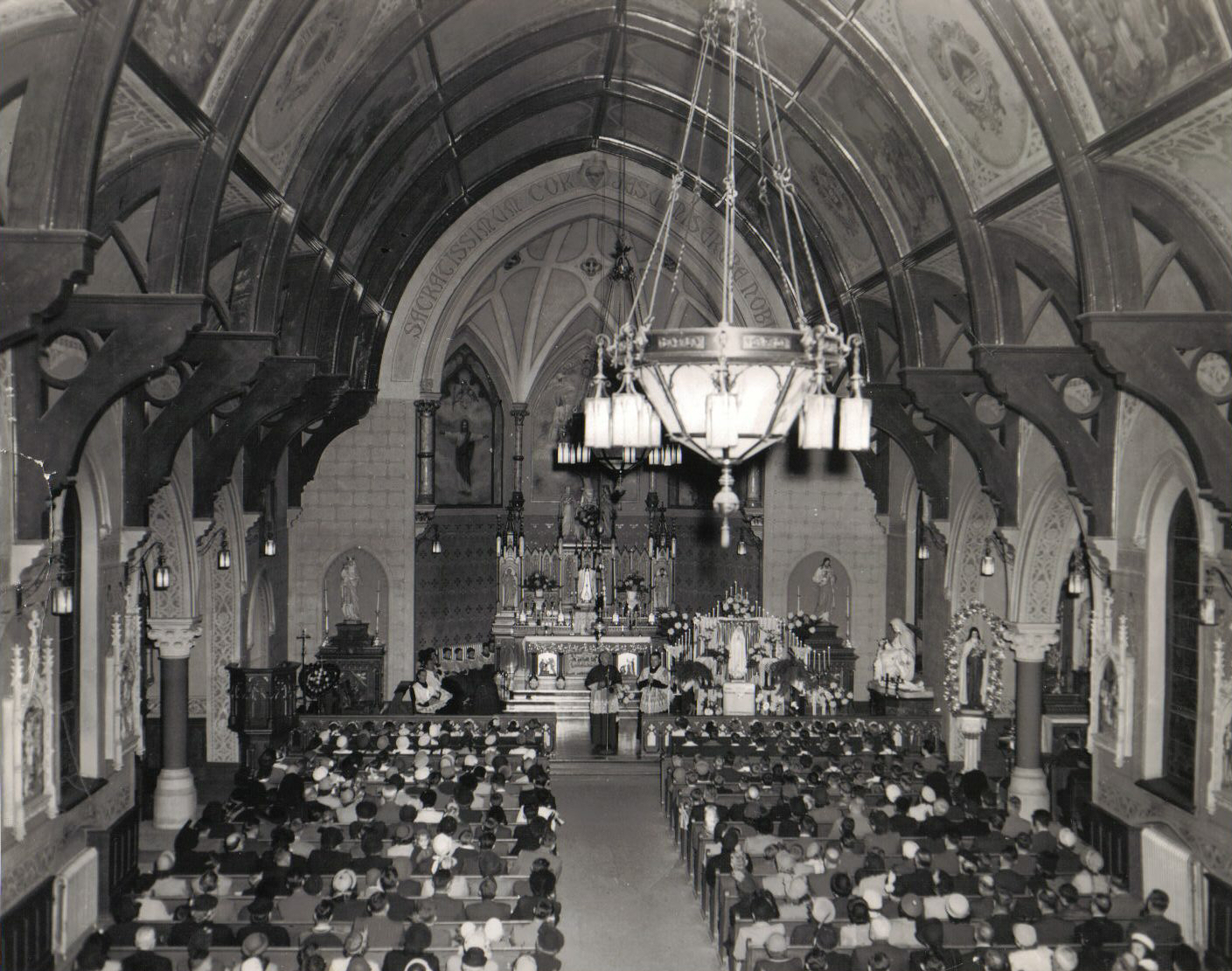
As you can see, the church was once very elaborately decorated. The possibilities are that, 1: either they got a priest and council in the past who wanted things to be simpler and more plain, who painted over everything, including the statues. (it happened. I know a few churches where hundred year old frescoes were given the roller treatment- all in the name of the Spirit of Vatican 2, of course.) or 2: The paintings and stenciling were getting old and in need of either restoration or replacement. Attendance was dropping around that time, and in the face of falling revenues, the priest opted for the cheaper alternative of a bucket of paint and a honking big roller. I suspect the second scenario is more likely. The priests I know who wanted the church plainer and more in keeping with some ancient "authentic" Catholicism would not have hesitated to have ripped out the altars. Fortunately, the altars have survived and are beautiful. If I ever win the lottery, I would gladly give them enough money to bring the church back to its older state. In the meantime, Mother and I tossed ten bucks into the collection plate.
I should add, the priest as Sacred Heart gave a fine sermon at the Mass we attended. He pointed out that the secular media, in the wake of Benedict's retirement, is calling the Church "divided". This is odd, as the media up here, enraptured with multiculturalism, praises diversity where ever they find it, but in the Church, they call it "division." "We are not a divided Church," the priest said. "We are a diverse Church." I thought he was making an excellent point, and he preached it well.
Both churches are in the diocese of Hamilton. Mother and I frequently go there for our little outings to see some older churches. Somehow, it seems as if more churches in that diocese, and in a few other outlying dioceses, have survived better than the churches of the Toronto archdiocese. So many of our churches were gutted and painted over in the chaos following the council. It is terribly, terribly sad to go into some of our older, finer churches, and see a hollow shell, a shadow of its former glory, the gifts of generations wiped clean and thrown in the trash, for no reason whatsoever. It is also wonderful to see that there are those that survived and continue to flourish, seemingly against the odds.
25 February 2013
My Birthday,
Yippee. Another year closer to death than I was this time last year, which is about the only upside of birthdays.
To stave off the inevitable depression that comes around on this day, I took the day off and headed downtown with my camera, hoping to see... something. I don't really know what. I ended up going over some of the old places, some of which I should have avoided like poison.
I wound up stomping around the old U of T area. Not my alma mater, but I spent a fair amount of time in the area during my post graduate work, as their libraries were superior to the ones at my university. When you see the old buildings, you can tell that most of the old colleges were founded by pastors, parsons and bishops, as the buildings often look like old churches.
The college is touted as the home of theological studies at the university. There is supposed to be a chapel in there somewhere. I thought it would have been in the wing sticking out towards the camera, but that turned out to be a common room. Somewhere nearby is an ugly statue called "the crucified woman." It's there because... well, just because.


As a sign of the education, this was on the door of St Michael's college- as series of upcoming talks at nearby St Basil's. Christ the Clown, Christ the Rebel, Christ the Woman, everything but Christ, Son of God, Lord and Saviour.
Another sign of the times, photographed through the door:
 I don't know if they are seriously asking the question, or if they are asking a rhetorical question, suggesting that there is nothing wrong with it. The line underneath the question could be read either way, but if they are asking a serious question, I could give them plenty of answers. One of the things I do not miss after I dropped post graduate studies is smiling through gritted teeth and nodding as some radical feminist spewed whatever nonsense was in vogue at the moment, and having to agree with them, or risked getting charged with sexism and sexual harassment. "Yes, I see your point and I completely agree. All f***ing men should have their f***ing balls cut off. In fact, I insist you cut mine off right now. Shall I get you some scissors?"
More colleges with chapels.
 Wycliffe Colllege Chapel. Couldn't get in.
 Trinity College Chapel. I could get in, which was pleasant, as I consider it the most beautiful chapel in Toronto, Anglican or not. I wish I was a better photographer.

 The chapel. It is a combination of starkness and elegance. Wonderful. What the picture cannot show is the acoustics. This place has the best acoustics I know of anywhere in Toronto. Gregorian chant sounds magnificent in here. I, ahem, tried it out. A little. My voice is not really well suited for chant, unfortunately. If I were ever to record an album, I would do it here.
 One of the curious things about the chapel is that it has a side chapel within. This is the Lady's Chapel, used for smaller and more intimate gatherings.
 This is the positive organ within the Lady's chapel. It is small, has only one manual and no pedals. The three knobs on the top are stop knobs, so this is actually a fairly substantial organ for its size. The small box on the right houses the blower.
 A close up shot of their sanctuary. The forward table serves as a reminder to me that Catholic churches were not the only ones that suffered unfortunate renovations in the seventies and eighties.


 But as I said, so much of the old campus looks ecclesiastical, it is hard to tell. There is one building that bears a strong resemblance to a cathedral, but it's just a cafeteria. Then there is this structure near the centre of campus.


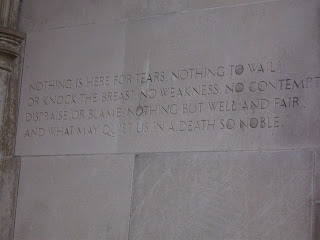


 Some on the left.


In some ways, it is similar to the Trinity chapel, but the windows were either yellow to begin with, or have gone yellow, and the result is that the chapel is rather dark and dingy inside.

Like the Trinity chapel, it has a chapel within the chapel, but it was so dark the photo did not turn out at all. It also has a large organ. I suppose the Presbyterians had money, too.
 By now, I'd had enough of University. Too many bad associations. I was young once, and a scholar, among the best of my school. However, as is so often the case for me, I may be talented, but not talented enough. I worked hard, but not hard enough. I walked among these young kids, their lives in front of them, and it just drove home how poorly I have used my talents, and how little I achieved with them. It was once my place among such as these, but now I was invisible. If they noticed me at all, they may have thought I was a janitor, or perhaps a hobo who had wandered on to their campus by mistake. My time had pased. The university belonged to them, now. I was an intruder. It was time to leave.
One thing those of you who don't live here should know about Toronto: this stupid building follows you where ever you go.

So does war. This was just down the road on University Avenue.


 I have no idea what a beer academy is, but I approve.
Here is a statue of St Michael over one of the entrances to St Michael's Hospital. It think it is interesting to compare it to the new statue placed over the entrance to the Cathedral.

 St Patrick on the right, obviously, and St Joseph, I believe.
 And Sts Peter and Paul, I think. Paul certainly. I think that is Peter holding keys.

To stave off the inevitable depression that comes around on this day, I took the day off and headed downtown with my camera, hoping to see... something. I don't really know what. I ended up going over some of the old places, some of which I should have avoided like poison.
I wound up stomping around the old U of T area. Not my alma mater, but I spent a fair amount of time in the area during my post graduate work, as their libraries were superior to the ones at my university. When you see the old buildings, you can tell that most of the old colleges were founded by pastors, parsons and bishops, as the buildings often look like old churches.
 |
| Emmanuel college. |

Victoria College. Nice place. Obviously Victorian. Less church-like than the others. It resembles nearby Queen's Park (our provincial legislature). There is another chapel inside this one, but the door was locked and I could not get in.
Here's part of the Catholic contribution to the University of Toronto.

More and Fisher house, the residence of St Michael's college, and home of the pontifical medieval studies institute, built on land donated by Sir John Elmsley. As I recall from the guys I used to know who lived there, the guys living here try and honour the memory of the martyrs for whom the residence was named and the gift of the man who gave of his treasure to bring this place into being by convincing as many coeds as possible to come into their rooms where they may shag them rotten. Well done, men of St Michael's college.

Another sign of the times, photographed through the door:

More colleges with chapels.


Entrance to Trinity. I like the sad and happy faces that flank the door. I didn't take pictures of the inside, except for the chapel, as I did not want to risk disturbing any classes, or drawing attention to the fact that I really didn't belong there. But everything inside screams quality and money. This is where the more genteel Torontonians of yore sent their sons to be educated


The rear of the chapel. In the upper shadows one can make out the main organ and the choir loft. Impressive for such a small space. As I said: money.
Throughout the U of T are many buildings that look like they were once chapels, but are so no more. For instance, the two below, one of which is now a bookstore.


It looks like the bell tower of a church, but that is only half right. It is a bell tower- it houses a carillon- but it was raised as a memorial to the students and alumni of the University who died in the wars.

These are the names of the ones who died in the first.
An inscription nearby tries to give meaning and glory to those who made the ultimate sacrifice.

I suspect these words were not written by a veteran, or, at least not a front line veteran. No one who had seen the slaughter on the Western Front thought it a glorious thing to die so. Most of the men who went there came back and never spoke of what they saw. There is another inscription opposite this one, which was written by a veteran: John McRae.

It's Flanders Fields, if you can't read it. It's images are calmer and more subdued: sleep and dreams of peace, duty, the passing of the torch, and a fear of betrayal. Sadly, the man of the First World War were betrayed, not by those who took their place, but by those who sat in command over them With their blood the young men gave the world a chance to be made anew, but instead, the old men decided to make the old world all over again. The result was another war, fought by the sons of the men who made it home. Their names are under the tower itself.

Some on the right.


As far as I know, the carillon in the tower is now silent.
I went on to check out one more chapel: The one at Knox college,

In some ways, it is similar to the Trinity chapel, but the windows were either yellow to begin with, or have gone yellow, and the result is that the chapel is rather dark and dingy inside.

Like the Trinity chapel, it has a chapel within the chapel, but it was so dark the photo did not turn out at all. It also has a large organ. I suppose the Presbyterians had money, too.

One thing those of you who don't live here should know about Toronto: this stupid building follows you where ever you go.

So does war. This was just down the road on University Avenue.

It is a cenotaph raised to dead from the First World War. The symbolism is important. The three lions represent the British Empire. The sleeping lion is the Empire at peace, but the two wakeful lions are the Empire ever vigilant, ready for danger. The position of the soldier sends the same message: at rest, but gun ready.

He is shown wearing his great coat. The men often abandoned their great coats when going over the top, as they often became waterlogged and heavy, and weighed the men down. Generally, they only wore them in the trenches, thus giving them their more common name: trench coats.
I moved on.

Here is a statue of St Michael over one of the entrances to St Michael's Hospital. It think it is interesting to compare it to the new statue placed over the entrance to the Cathedral.

Speaking of the Cathedral, and because I always end up back there, sooner or later, I saw that the new statue of Michael is not the only statue they have raised.


And St Michael in his new niche. Really, while this isn't my preferred style of statue, it could have been so very much worse, I will not complain about it.
While at the Cathedral, I took advantage of Confession before Mass, and cleansed my soul of old sins. Starting off another year is bad enough, no need to do it with the old baggage. I stayed for Mass.
I wandered around town some more before turning round and heading home. I thought about seeing a movie, but there is nothing out there I want to see. I probably wouldn't enjoyed anything anyway. I could have taken more pictures, but I didn't feel like it anymore.
Another great year underway. Hoo rah.
Subscribe to:
Posts (Atom)