Showing posts with label wise words. Show all posts

5 March 2013

Travels with mom

Took mom out for a drive on the weekend.  She likes country scenes, old churches, old barns, anything pretty, really.  She's easy to please, so I don't mind taking some time to make her happy every now and then.  (One of my co-workers, his mother is impossible to please.  She is, according to him, always complaining, and upset that her life is not as good as she wants it to be, and nothing they do can change that.  As a result, he and his brothers and his father no longer try.  One time, when speaking to my coworker about my mother, he said: "Barns?  You show her an old barn, and she's happy? You don't know how lucky you are.")

I had planned to take her on a short jaunt to nearby Hamilton, but I found I had less to do at her house than I had thought, and we had the entire day ahead of us, so I took us a little farther afield, and we travelled instead into Bruce County on the weekend.  Plenty of scenery and farms and old towns to see.  I was aiming for two churches that I had found on the net and have mentioned in the past:  Immaculate conception in Formosa, and Sacred Heart in Mildmay.  In my careful preparations for this little jaunt, I had the foresight to pick up extra batteries for the camera, and then forgot to bring the camera itself.  So I got some photos from the net, instead.

Immaculate Conception, Formosa.


Sacred Heart, Mildmay

Photos are often deceptive.  In this case, I should say that Immaculate conception is prettier in real life than it is in the photos, and Sacred Heart's photo is a little prettier than the church itself, although both are wonderful churches.  The altars in both churches were made by the same local family, the Durrer's, and the altars have fortunately been preserved.  (As my sister said on seeing the photos:  "Thank God they didn't have the money to rip them out!")  Immaculate Conception seems to have survived virtually intact.  Sacred Heart did go through some renovations in the seventies and eighties, although they appear to be trying to restore some of what was lost now.  Here's another photo from their website showing the church in it's earlier state:
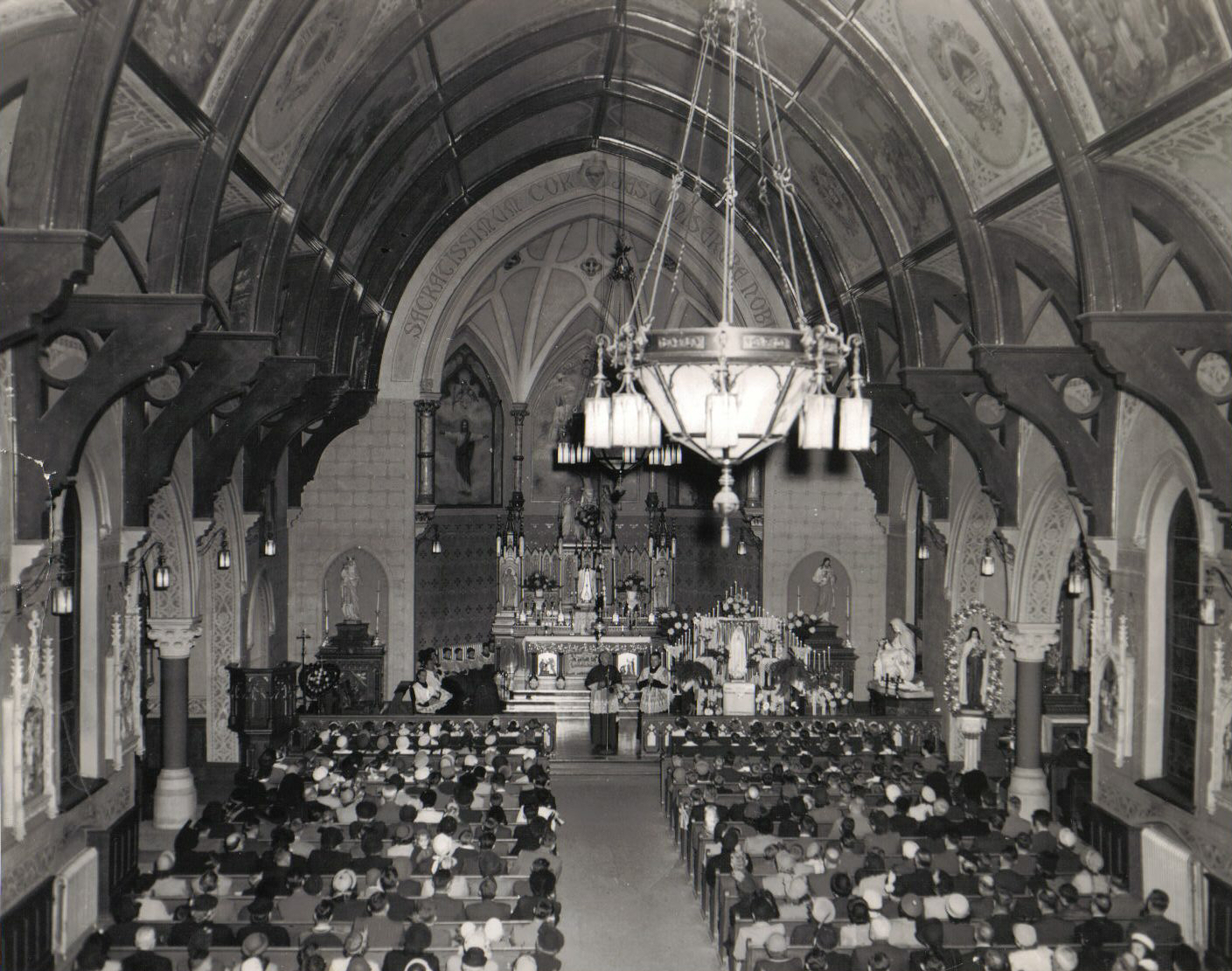

As you can see, the church was once very elaborately decorated.  The possibilities are that, 1: either they got a priest and council in the past who wanted things to be simpler and more plain, who painted over everything, including the statues.  (it happened.  I know a few churches where hundred year old frescoes were given the roller treatment- all in the name of the Spirit of Vatican 2, of course.)  or 2: The paintings and stenciling were getting old and in need of either restoration or replacement.  Attendance was dropping around that time, and in the face of falling revenues, the priest opted for the cheaper alternative of a bucket of paint and a honking big roller.  I suspect the second scenario is more likely.  The priests I know who wanted the church plainer and more in keeping with some ancient "authentic" Catholicism would not have hesitated to have ripped out the altars.  Fortunately, the altars have survived and are beautiful.  If I ever win the lottery, I would gladly give them enough money to bring the church back to its older state.  In the meantime, Mother and I tossed ten bucks into the collection plate.

I should add, the priest as Sacred Heart gave a fine sermon at the Mass we attended.  He pointed out that the secular media, in the wake of Benedict's retirement, is calling the Church "divided".  This is odd, as the media up here, enraptured with multiculturalism, praises diversity where ever they find it, but in the Church, they call it "division."  "We are not a divided Church," the priest said.  "We are a diverse Church."  I thought he was making an excellent point, and he preached it well.  

Both churches are in the diocese of Hamilton.  Mother and I frequently go there for our little outings to see some older churches.  Somehow, it seems as if more churches in that diocese, and in a few other outlying dioceses, have survived better than the churches of the Toronto archdiocese. So many of our churches were gutted and painted over in the chaos following the council.  It is terribly, terribly sad to go into some of our older, finer churches, and see a hollow shell, a shadow of its former glory, the gifts of generations wiped clean and thrown in the trash, for no reason whatsoever.  It is also wonderful to see that there are those that survived and continue to flourish, seemingly against the odds. 

19 May 2011

The best statement I have read on Universae Ecclesiae yet

While doing some research for a future post, I dropped by the website of St Mary's parish in Norwalk Connecticut.  The pastor there, Father Greg J Markey, has written for his "from the pastor" column of the website the best  statement I have yet seen on Universae Ecclsiae.  I reproduce it here without comment, as I believe it speaks for itself.

This past Friday, May 13, 2011 (Our Lady of Fatima), the Pontifical Commission Ecclesia Dei released the Instruction Universae Ecclesiae (To the Universal Church), "on the application of the Apostolic Letter Summorum Pontificum." Summorum Pontificum was Pope Benedict XVI’s 2007 motu proprio which, as the Instruction states, “made the richness of the Roman Liturgy more accessible to the Universal Church” (1).

The implementation of Summorum Pontificum in continuity with the Second Vatican Council has been a defining part of my time here as pastor at St. Mary Church and it is worth reflecting on this new Instruction in light of our experience.

In reading Universae Ecclesiae, I cannot help but think that we here at St. Mary Church are implementing the Holy Father’s liturgical vision. The heart of the Instruction states: “The Roman Missal promulgated by Pope Paul VI and the last edition prepared under Pope John XXIII, are two forms of the Roman Liturgy, defined respectively as ordinaria and extraordinaria: they are two usages of the one Roman Rite, one alongside the other. Both are the expression of the same lex orandi of the Church. On account of its venerable and ancient use, the forma extraordinaria is to be maintained with appropriate honor” (6).

Where is this liturgical vision being carried out in the Catholic Church today? There are many parishes that will avoid any positive reference to the extraordinary form. There are also a small number of parishes, most of which are run by religious orders, that will do the extraordinary form exclusively, without the ordinary form. There are parishes that do both the ordinary and extraordinary forms, but where the extraordinary form is a fringe element, handled by an external group of priests at odd Mass times. Who, then, is going to bring the extraordinary form and ordinary form together in one parish, “alongside one another”? By the grace of God, St. Mary Church in Norwalk is doing just this.

The Instruction goes on to say that the extraordinary form is to be “considered a treasure to be preserved” (8, a) and that the bishop is “to ensure respect for the forma extraordinaria of the Roman Rite” (13). Therefore, those who feel a certain hostility toward the Traditional Latin Mass need to examine their consciences as to whether they are thinking with the mind and heart of the Church, or whether more secular models of Catholicism have seeped into their thinking.

On the other hand Universae Ecclesiae wants to avoid the other extreme as well: “The faithful who ask for the celebration of the forma extraordinaria must not in any way support or belong to groups which show themselves to be against the validity or legitimacy of the Holy Mass or the Sacraments celebrated in the forma ordinaria” (19). While some of the faithful may have a preference for the extraordinary form, groups which attack on the legitimacy of the ordinary form are not part of the Holy Father’s vision of the liturgy.

Nonetheless, the implementation of the liturgical reforms of the Second Vatican Council, which ultimately became the ordinary form of the Mass, is not above criticism. Speaking at an international conference on the liturgy earlier this month, Pope Benedict XVI stated that the purpose of the reform, “was not mainly to change the rites and texts” but to “renew the mentality” of worshipers. But he acknowledged that the implementation fell short of this goal. “Unfortunately,” the Holy Father stated, “the liturgy has perhaps been seen – even by us, pastors and experts – more as an object to reform, than a subject capable of renewing Christian life.”

While there have always been numerous liturgical rites within the history of the Catholic Church, it is a unique and even confusing historical development to have two official forms of the one Roman Rite. How are the two forms and their respective calendars to be reconciled? As a pastor who has been actively promoting a reverent celebration of both forms for almost four years now, there have been no shortage of strong opinions directed at me from across the liturgical spectrum trying to answer this question.

I think it must be said that the people have a right to come to church and to have the same holy Mass, performed with the same rituals every week so that through the repeated gestures and symbols, the Sacred mysteries are properly communicated. However, with so many changes, and so many liturgical abuses since Vatican II, the faithful have become the arbiters of good liturgy; a position that they have historically never possessed. Perhaps, as Martin Mosebach has written, this is one of the greatest tragedies of the post-Vatican II era of liturgy: rather than coming to worship the Triune God and humbling accepting the liturgy as a gift from heaven, the people in the pews have become self-proclaimed liturgical experts. As Mosebach writes, “I go to church to see God and come away like a theatre critic.”

Liturgical abuses became so bad after the Council that even the Congregation for Divine Worship’s instruction, Redemptionis Sacramentum, advises the faithful to do, “(A)ll that is in their power to ensure that the Most Holy Sacrament of the Eucharist will be protected from any and every irreverence or distortion and that all abuses be thoroughly corrected. This is a most serious duty incumbent upon each and every one, and all are bound to carry it out without any favoritism” (183). Therefore, it is not surprising that so many of the laity have strong opinions, even if some of these opinions are uninformed.

As a priest, I have to be honest in saying that it is a challenge to offer the Roman Rite well here at the parish, with so many legitimate options: one Holy Mass I am offering the Sacrifice ad orientem, the next Mass I am offering It versus populum; one Mass is in Spanish, the next is in Latin; One Mass we are chanting the Latin Mass parts, the next we are reciting them in English; one Mass I am reciting the Canon out loud, the next the Canon is silent. This is the historical period that we are living in, and this is part of being a faithful Catholic in the year 2011.

For the future, Pope Benedict XVI has written that “the two forms of the usage of the Roman Rite can be mutually enriching.” There is much speculation as to what this mutual enrichment will look like. Currently, I think the common element in both forms is what the Pope calls the ars celebrandi, or the art of proper liturgical celebration. More specifically, the ars celebrandi is the “faithful adherence to the liturgical norms” (Sacramentum Caritatis, 37), and a manner of offering which fosters “a sense of the sacred” (40) and “awe for the mystery of God” (41).

I think all of the clergy here at St. Mary Church practice this ars celebrandi well, and while we have many liturgical options here at St. Mary Church, I think this common ars celebrandi is evident. I am often told when parishioners have visited other parishes on vacation, or for various Sacramental celebrations, how they miss the reverence and devotion that goes on here during our Masses. Even our children have told me that they have been surprised by the lack of reverence when they have visited certain other parishes. I have also been told when parishioners notice this ars celebrandi in other parishes, with hope in their voice. Therefore for now, the ars celebrandi is the common bond of the two forms.

Where will this “mutual enrichment” of the two forms of the Roman Rite lead? Perhaps only the Holy Spirit knows but after the release of Universae Ecclesiae this past week, Cardinal Kurt Koch stated that the pope’s ultimate goal is not simply to allow the old and new forms to coexist, but to move toward a “common rite.”

For this to be done the Church’s liturgy must be offered in continuity with the Church’s tradition, as the Pope has made clear, and not seen as a break, where people make a distinction between a pre-Vatican II and post-Vatican II liturgy. This will be difficult because there are not a small number of Catholics who seem to be embedded in the liturgical manner and music of the 1970’s and 1980’s, and unable to view the liturgy outside of this period. There are even those who have a curious self-hatred for things Catholic, like any use of Latin in the Mass. Obstacles like this must be overcome.

We here at St. Mary Church are seeking to implement the liturgical vision of Pope Benedict XVI, with the two forms “alongside one another.” No doubt there will be criticism of this liturgical vision as being “too conservative” or even “self-righteous,” yet our response must be in imitation of the Pascal Lamb, who “when reviled did not revile in return” (1 Peter 2:23). If we are attempting to root ourselves in the truth, we must be equally rooted in charity.

For anyone who has eyes to see, there is something quite amazing going on here at St. Mary Church. There are many gifted people who are being attracted to St. Mary Church from far and wide, and what is happening is larger than any one of us: the growing number of young families, the devoted altar boys, the student schola, the ethnic diversity – yes, there is something amazing going on here at St. Mary Church and I am very proud to be part of it.

Sincerely in Christ,

Fr. Greg J. Markey
frmarkey@hisnet.org


21 December 2010

Best Christmas special

At this time of year there is always a debate among bloggers which Christmas movie or television special is the best, and which are the worst, and so on. Ignoring the worst, because I can't be bothered with the terrible stuff and others have done a good job, and admitting there are several good ones out there I like and enjoy watching, I will go straight to the best.


This one.


22 July 2009

A confession story

I just saw a story of Fulton Sheen leading, rather forcefully, a woman into confessional, and it reminded of another story of confession told to me by a priest long ago.

There was a certain sainted priest of long ago who was well known for his ability at giving confession. (I believe it may have been St Philip Neri.) One day a rich man from the city came to confess to him. It was the first confession the wealthy man had in years, nor had he been to church in that time either. The priest began to give him his penance. "I want you to go to church once a week, and confession once a month..." the priest began.

"No no no," said the man. "I am an important man, and far too busy. I don't have time for that. Give me a penance that doesn't take up so much of my time."

"Then I want you to say the rosary every day and..." the priest began again.

"No no no. I don't have time for that. Give me something that takes up less of my time," said the man again. He repeated it the next time the priest began to suggest a confession, and the time after that.

"In that case," said the priest. "I have something very simple and easy for you to do."

"What is it?" asked the man.

The priest asked to see the man's hands. He took the man's hands in his own and showed the man how the lines on each palm can form the letter 'M'. "Every morning when you wake up, want you to look into your hands and see the two M's, and when you see them, understand them to mean 'momento mori': 'remember death.'"

The man agreed that this was a brief enough penance, and off he went.

A year passed, and the priest and the man met again. The man rushed to the priest and thanked him for that penance. "I now go to church and say the rosary every day, and to confession every week. I have given half my money to the church and I no longer swear as I once did, all thanks to you." He proceeded to thank the priest over and over for helping lead him to his new life, all because he forced him in confession to remember his end.

13 April 2009

He has died, and now is risen

I saw a saintly quotation over at Larry's site, can't remember which saint it was, which sums up my feelings this Easter Monday: "I could die of shame that I have not already died of gratitude."

28 October 2008

Here and There

A few quick notes.

First:

The other day I was with mother and I was telling her about how a local priest conducted Mass, and the number of abuses he committed. (note: this is not my parish priest. I normally avoid my local parish, but there are times when it is the only option.) Mother listened patiently, and then said: "Instead of being critical, you should pray for him."

To which I said: "You mean, like for God to send an avenging angel or purifying fire?"

She just gave me The Look.

She was right. We should do what we can to bring an end to abuses, and our major tools are prayer, letters to appropriate officials, followed by more prayer.

I decided a while ago I was going to try and avoid airing dirty laundry over the internet, but I realized my heart never really changed, and wherever I went I often found myself rating the Mass and cataloguing mistakes, rather than praying and worshipping. I need to adjust my attitude. So while I pray for God to open the eyes and mend the hearts of some of His priests, I pray for him to do likewise for me.

Second:

I have been toying with the idea of doing a series of posts on Canadian history, particularly but not exclusively its history of war- I mean, more posts on that subject than usual. I realize that these posts don't get much in the way of comments and probably aren't the most popular, but after watching Passchendaele and the poor job it did in representing our history I feel like trying to do something to rectify the situation, even if it is for my thirty or so daily readers. So I have decided to go ahead with the series of posts.

I don't know why Canadians do so badly with our history. So often we try to make the figures of our past like the people of the present. In our history and media the writers and artists seem to honour people most like themselves: not those who believed, but those who doubted; not those who stood firm, but those who wavered; and anyone who seemed to have a sign of greatness must be reduced to the merely human, (unless they happened to be the personal hero of the artist) and if no wavering and weak character can be found in history, one must be invented so the modern audience can 'relate'.

So I'll be preparing a series of posts over the next few weeks, mainly leading up to Remembrance Day, telling the stories of some good people and a few rogues from our past. The stories will mainly come from war, but not all of them. I hope to start by the end of the week.

5 September 2008

Good Quotation

In part of my studies for my vocal coach, I was looking up various renditions on youtube of the aria "Nessun Dorma". As I sifted through each, I began reading the comments, and many of them were vile. Everyone, it seems, has their favourite version, their favourite singer, and they feel compelled to explain how ever other version and singer is wrong, or does not measure up to their favourite, and everyone who disagrees with them is stupid.

In the middle of this was one ironic comment with which I fully and wholeheartedly agree. The commenter wrote: "In all the world there are only a few people who can sing this song, but millions who can tell them how they are doing it wrong." Absolutely.

27 March 2008

Pitiless truth and truthless pity

Louise over at Purcell's Chicken Voluntary has a good post based on a quotation from Chesterton. I quote:

Chesterton had an uncanny ability to see the big picture. He said that in a broken society, two things happen: the vices run wild and do great damage, but the virtues also run wild and do perhaps even greater damage "because they are isolated from each other and wandering alone."

Thus, there will be some who care only for truth and others who care only for pity. But with those on the one side, "their truth is pitiless," and those on the other side, "their pity is untruthful."

Good words, good to remember. I see the relevence of this almost everywhere I look, and the common thread to both sides is pride, pride in holding a truth which we do not possess, or pride in pushing pity beyond the truths we are given.

Do you ever think someone is laughing at our stupidity and arrogance?